FICTION — Rock Ptarmigan News Service
RIVER BEND, Minn. — A bald eagle interrupted a regional watershed-restoration announcement Friday to remind assembled reporters that it remains “the primary visual representative of the United States.”
The eagle appeared approximately six minutes into a press conference along the fictional Upper Cedar River, landing on a cottonwood branch directly above a podium displaying the flags of three conservation organizations.
Its arrival caused nearly every photographer to turn away from the speaker.
“We had just begun explaining a five-year riparian restoration project,” said biologist Dr. Lena Ortiz. “Then a bald eagle landed behind us, so for practical purposes the event was over.”
The adult eagle remained perched for approximately twelve minutes.
During that time it faced the river, rearranged several feathers, scanned the water, and accepted what observers described as “an inappropriate amount of symbolic credit.”
A written statement later attributed to the bird said the appearance was intended to “reaffirm the continued connection between this office and the Republic.”
Ortiz said there is no office.
“It’s a bird,” she said.
The bald eagle nevertheless has a unique cultural burden.
The species was adopted as the national emblem in the eighteenth century and remains one of the most recognizable national symbols in the United States.
Its biological history is also consequential. Bald eagles suffered severe declines in the twentieth century due to habitat loss, illegal shooting, and contamination including DDT. After legal protections, the DDT ban, habitat work, and conservation efforts, the population recovered enough to be removed from the federal endangered species list in 2007.
“They are an extraordinary conservation story,” Ortiz said. “That does not mean this individual eagle personally completed the restoration plan.”
The eagle did not respond.
It shifted one foot.
Reporter Daniel Price asked whether the animal’s presence could be considered an endorsement of the project.
“No,” Ortiz said.
“Could it be considered a general endorsement of freshwater?”
“No.”
“America?”
Ortiz looked toward the river for several seconds.
The event became further complicated when a Common Raven landed in a nearby tree and began calling loudly.
Witnesses interpreted the raven’s behavior as dissatisfaction with what one attendee called “the federal branding disparity.”
Ortiz asked everyone to stop assigning institutional opinions to birds.
The eagle remained.
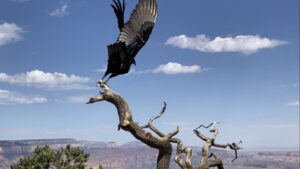
At one point it opened its wings, briefly displaying a wingspan of roughly seven feet.
Three photographers moved backward.
A county commissioner who had been scheduled to speak next quietly folded his prepared remarks and placed them in his coat.
“You don’t follow that,” he said.
The watershed announcement eventually resumed under diminished media attention.
Officials described the restoration work, which includes streambank stabilization, native vegetation, and improvements intended to reduce sediment entering the river.
The eagle looked down once.
Price asked whether that indicated approval.
Ortiz said the press conference would now take questions “about water.”
At 11:18 a.m., the eagle took flight and followed the river downstream.
The press group watched it for nearly a minute.
Then the same eagle abruptly changed direction toward a gull carrying what appeared to be a fish scrap.
Ortiz pointed.
“There,” she said. “That is the bird’s actual policy priority.”
Related: An Interview With a Bird That Declined Identification · Birders Propose a New Field Mark: Confidence · Area Owl Has Known About You for Some Time
Leave a Reply