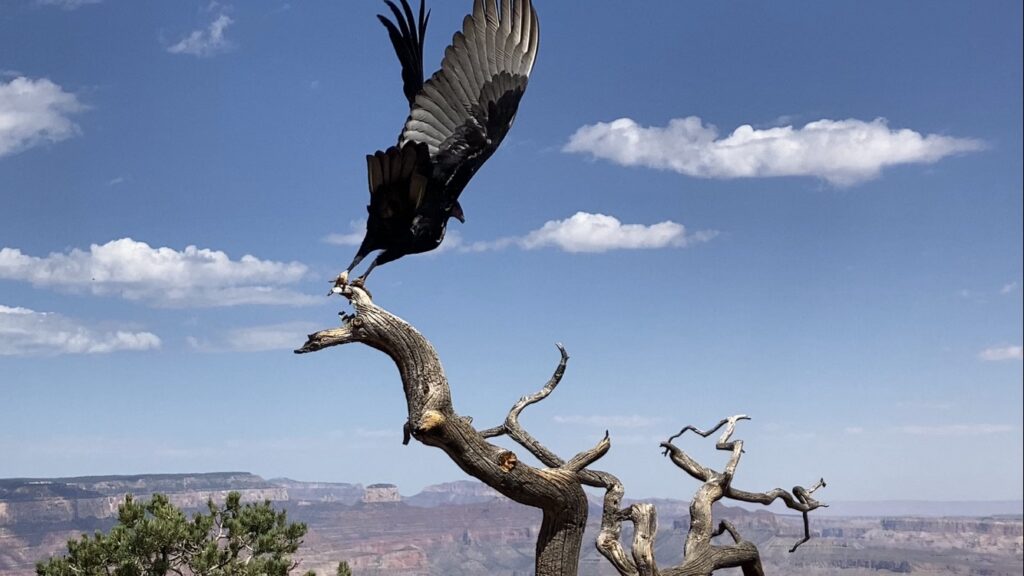
A Turkey Vulture is difficult to market.
The head is bare and red.
The diet is dead animals.
When overheated, it may defecate on its own legs.
When threatened at close range, it may vomit.
The flight, at least, is elegant.
This combination has prevented the Turkey Vulture from achieving the cultural status of the Bald Eagle, which also eats carrion but has considerably better branding.
This is unfair.
Turkey Vultures are extraordinarily specialized scavengers.
They are also useful.
Start With the Nose
Birds are often described as having poor senses of smell.
Turkey Vultures are a major exception.
They have a highly developed olfactory system and can locate carrion by scent.
This is especially useful when a carcass is hidden beneath forest canopy and cannot simply be spotted from the sky.
Smithsonian research has described the Turkey Vulture as a kind of aerial bloodhound, tracking odor plumes while circling over landscapes.
This creates one of the species’ defining differences from Black Vultures.
Black Vultures rely more heavily on vision and may watch Turkey Vultures to locate carcasses.
Then, because nature dislikes tidy partnerships, Black Vultures may displace them at the food.
One species has done the olfactory research.
The other has arrived for lunch.
The Flight Is an Energy Strategy
Watch a Turkey Vulture for several minutes.
The wings are held in a shallow V.
The bird rocks gently from side to side.
It circles.
It rarely seems interested in sustained flapping.
This is not laziness.
Soaring conserves energy.
Turkey Vultures exploit rising air—thermals and other updrafts—to remain aloft while searching large areas.
Their characteristic teetering posture helps manage lift while flying slowly and relatively low.
This matters because low flight can improve access to scent information.
The bird is doing two things at once:
- saving energy;
- sampling the atmosphere for death.
Efficient.
Specific.
Difficult to put on a national seal.
The Bald Head Has a Point
A featherless head makes aesthetic sense once the bird begins feeding.
Carrion is messy.
A head repeatedly pushed into a carcass would be much harder to clean if covered in dense feathers.
Bare skin is easier to keep relatively clean.
Vultures also spend time sunning.
The spread-wing posture may help with warming, drying and maintenance.
Again, the animal’s allegedly ugly features become less arbitrary once you stop judging it from a portrait and imagine the actual job.
This is sanitation equipment.
The Stomach Is the Important Part
Turkey Vultures eat material that can contain dangerous microbes.
Their digestive systems and immune defenses allow them to exploit food that would create serious problems for many other animals.
Cornell Lab summarizes this by noting that vultures can consume contaminated carrion without succumbing to several diseases associated with decomposing carcasses.
The exact microbiology is more complicated than the common “their stomach acid kills everything” explanation.
Research on vultures suggests that gut chemistry and microbial filtering play important roles, but the popular claims about precise stomach acidity are sometimes repeated more confidently than they have been measured in free-living birds.
The larger fact is secure:
Turkey Vultures are exceptionally well adapted to eating carrion.
This matters ecologically because carcasses are resources, and scavengers remove them quickly.
Without scavengers, dead animals remain available longer to microbes, insects and other consumers.
Vultures are part of the cleanup system.
The Smell Is Also Information About Time
Turkey Vultures generally prefer relatively fresh carrion.
This is useful because decomposition changes the chemical signals coming off a carcass.
The bird’s olfactory system can help locate dead animals at a stage when they remain usable.
That creates a strange relationship between chemistry and landscape.
A deer dies beneath forest cover.
Invisible volatile compounds rise into the air.
A bird moving hundreds of feet overhead intersects the scent plume.
It circles.
The circles tighten.
The bird descends.
This is not a cartoon scavenger waiting passively for something to die.
It is active sensory tracking.
Vomiting Is Defense
A Turkey Vulture confronted closely can regurgitate.
This is not a personality trait.
It is defense.
A stomach full of partially digested carrion is an effective argument for distance.
Young vultures at nests can also defend themselves this way.
The correct human response is straightforward:
Do not force a Turkey Vulture to demonstrate this adaptation.
Watch from farther away.
Very few wildlife encounters are improved by discovering the animal’s emergency stomach contents.
The Leg Problem
Turkey Vultures may also cool themselves through urohidrosis, defecating on their legs so evaporation lowers temperature.
This sounds like material a middle-school class invented to ruin lunch.
It is real.
The pale buildup sometimes visible on vulture legs can be the residue.
Birds have no sweat glands in the mammalian sense, and vultures spend substantial time exposed to sun.
Cooling strategies become creative.
This does not make the bird dirty in an evolutionary sense.
It makes the bird adapted.
Nature has no obligation to select solutions that look respectable in a field guide.
Vultures and Disease
The ecological value of vultures becomes especially clear where scavenger populations decline.
Studies outside North America have shown that losses of vultures can alter carcass persistence and scavenger communities with consequences for disease ecology.
Turkey Vultures in North America remain widespread and are currently considered a species of low conservation concern.
They still face hazards.
Lead fragments in carcasses can poison scavengers.
Poisons intended for other animals can enter carrion.
Vehicle collisions and persecution can kill birds.
The irony is difficult to miss.
A species helping remove dead animals can be harmed by what humans leave inside the dead animals.
Better Branding
Turkey Vultures will probably never replace Bald Eagles on currency.
They should at least receive better public relations.
They soar beautifully.
They smell exceptionally well.
They locate hidden carrion.
They tolerate a diet that would hospitalize you.
They remove dead animals from landscapes.
They cool themselves in a manner no tourism board will ever feature.
And when threatened, they carry a defense mechanism so unpleasant that the safest description is simply:
back up.
This is an excellent bird.
It is not glamorous.
Those are different categories.
Related: Ten Birds to Notice in the Canadian Rockies · The Woodcock Is a Perfectly Serious Bird Despite All Evidence · An Interview With a Bird That Declined Identification
Leave a Reply