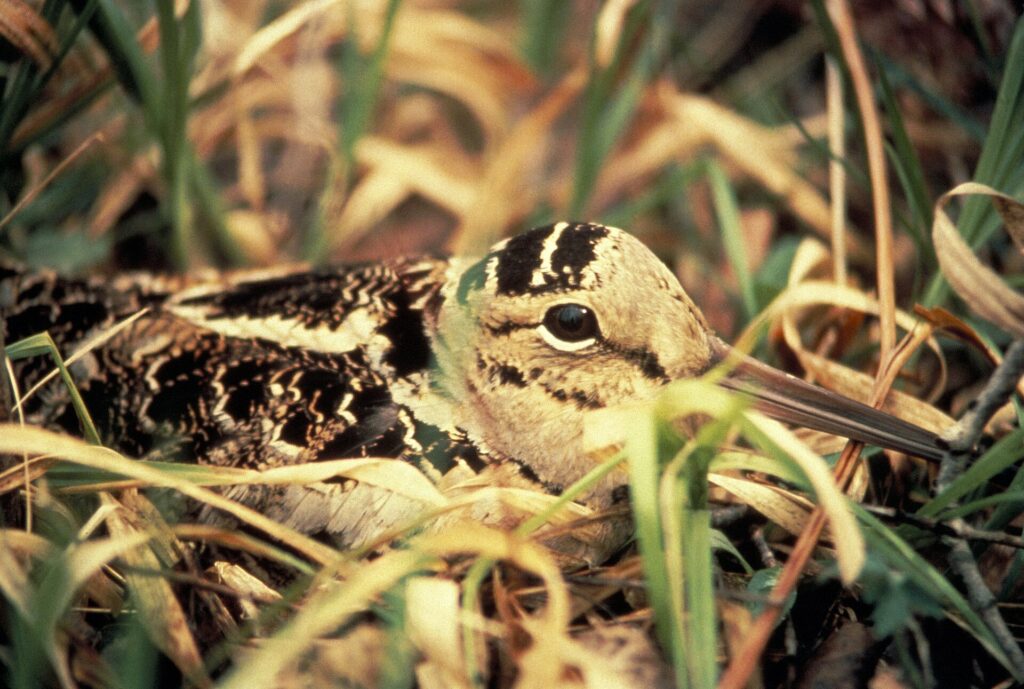
The American Woodcock is a shorebird that lives in the woods.
It has a long bill, a round body, short legs, eyes placed high and far back on the skull, and a walk that looks like somebody has attached a small motor to the hips.
At dusk in spring, the male stands in a field saying peent.
Then it launches into the sky, spirals upward while its wings make twittering sounds, circles overhead, and drops back toward the ground to do it again.
This is courtship.
The bird is serious.
We should try to be.
A Shorebird That Left the Shore
American Woodcocks belong to the sandpiper family.
That family contains many birds associated with beaches, mudflats and shorelines.
Woodcocks largely ignore this branding.
They live across eastern North America in young forests, shrubby fields, wet meadows, woodland edges and similar habitats.
Their favorite food is earthworms.
They obtain these by walking through damp soil and probing with the long bill.
The entire bird appears to have been redesigned around one central concept:
worm extraction.
The Bill Is Not Just Long
The woodcock’s bill is long and straight.
The tip is flexible enough to help seize prey underground.
This means the bird can insert the bill into soft soil and manipulate the tip while much of the bill remains buried.
That is specialized.
It also means the bird’s feeding posture puts the face close to the ground for long periods.
Which helps explain another bizarre feature.
The Eyes Are Almost on the Back of the Head
Woodcock eyes sit high and far back on the skull.
Cornell Lab notes that this arrangement provides a broad field of view while the bird has its head down probing for food.
The woodcock is therefore capable of monitoring for danger while the bill is underground.
This is excellent design.
It is also why the bird looks startled from nearly every angle.
The eye placement is not comic.
The face simply is.
The Walk
The rocking walk became internet-famous because it looks choreographed.
A woodcock may move slowly while rocking its body forward and backward, shifting weight heavily between steps.
One hypothesis is that the movement creates vibrations that cause earthworms to move, making them easier to detect.
Cornell presents this as a possibility rather than a confirmed mechanism.
That distinction is important.
The bird definitely walks like that.
Why it walks like that remains less certain.
Nature does not owe us explanatory closure merely because the video is funny.
Then There Is the Sky Dance
In spring, male woodcocks move into open singing grounds around dusk and dawn.
The display begins on the ground with the nasal peent call.
Then the male takes off.
It climbs in a broad spiral.
Air moving through specialized wing feathers produces a high twittering sound during flight.
At height, the bird begins a descending series of musical chirps before dropping back to the ground.
Then:
peent.
Again.
The cycle can repeat many times.
Aldo Leopold famously wrote about this courtship in “Sky Dance,” helping make the performance one of the most celebrated bird displays in American conservation writing.
The woodcock has been doing it without literary assistance for much longer.
The Male Does Not Help With the Kids
The display is energetically impressive.
Parental contribution is less so.
Males can mate with multiple females and do not provide parental care.
Females build simple ground nests, incubate the eggs and raise the chicks.
Young woodcocks leave the nest within hours after hatching, though they remain dependent on the female initially.
The male may continue displaying while females are already nesting.
The sky dance is therefore not evidence of domestic commitment.
It is advertising.
Habitat Is the Real Conservation Story
Woodcocks need a mix of habitats.
They use young forest and shrubland for feeding and nesting.
They use openings for courtship.
They may use different habitats for roosting and migration.
This dependence on early-successional habitat makes the species interesting from a forest-management perspective.
A forest is not one static condition that becomes “better” as it gets older.
Young forest, shrubland and disturbed patches support species that mature closed-canopy forest may not.
Historically, fire, storms, beavers, flooding and other disturbance created shifting mosaics.
Today, human land management often determines how much young forest persists.
This means woodcock conservation can involve cutting vegetation.
That sounds contradictory only if conservation is imagined as never touching anything.
Sometimes habitat needs disturbance.
Windows Are a More Modern Problem
Woodcocks migrate at night.
Like many migratory birds, they can collide with buildings and glass.
Fish and Wildlife Service reporting has highlighted window collision as a significant source of bird mortality and has used the woodcock as an example.
This is a less charming interaction between birds and human architecture.
The animal can navigate continental migration and still be defeated by transparent glass.
Bird-friendly building treatments are therefore part of modern conservation in a way Aldo Leopold never had to explain during the sky dance.
A Perfectly Serious Bird
The temptation is to make the entire article about how silly the woodcock looks.
This would be unfair.
It is also impossible to avoid completely.
The woodcock is:
- a forest shorebird;
- with eyes near the back of its head;
- a flexible earthworm-probing bill;
- a rocking walk;
- a nasal “peent”;
- and a male courtship routine involving a spiraling flight and mechanical wing music.
Every detail has a biological context.
Together they look like a dare.
The more useful reaction is admiration.
Evolution does not produce animals for visual consistency.
It produces workable combinations.
The woodcock works.
It works so well that the strange body has persisted across forests, fields and migrations while humans continue standing at dusk waiting for the bird to say peent and launch itself into the dark.
That is serious birding.
Despite all evidence.
Related: Ten Birds to Notice in the Canadian Rockies · An Interview With a Bird That Declined Identification · One Rare Bird, a Very Small Internet
Leave a Reply