The beginner birding problem is not merely that birds are difficult to see.
It is that several birds have declined to sound like birds.
A marsh makes a pumping noise.
A field produces a mechanical buzz.
Something in the night whinnies like a tiny horse.
A large white bird flies over making a sound that belongs in a prehistoric documentary.
All of these can be normal.
Here are ten birds that expanded the definition of bird noise without consulting anyone.
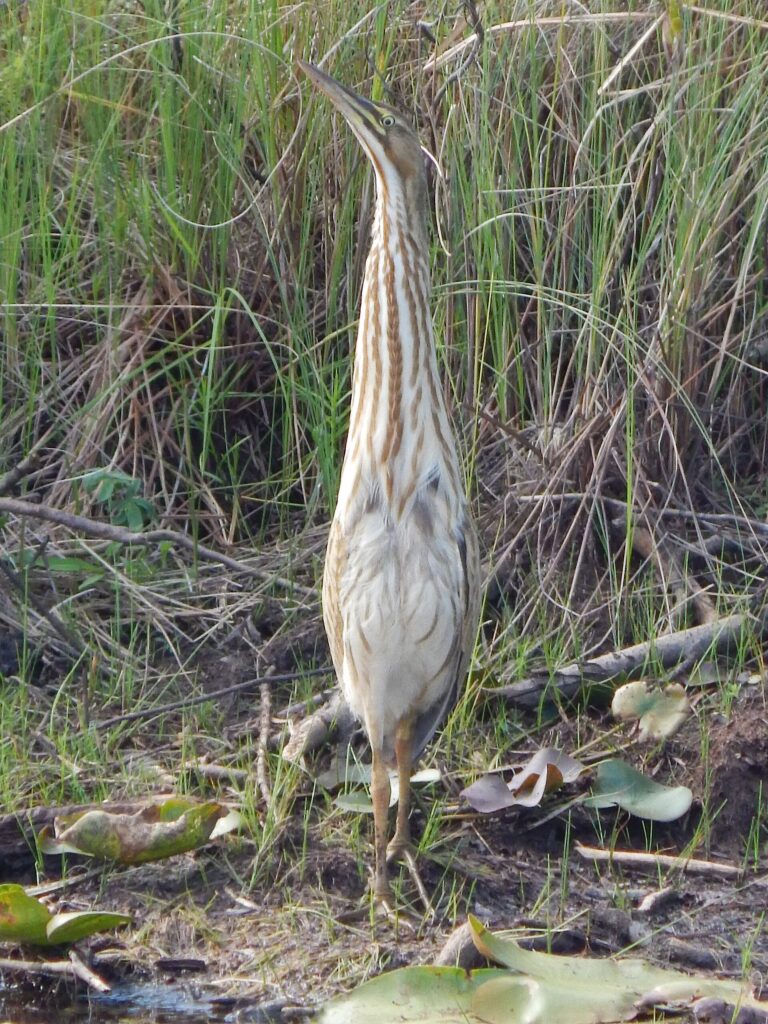
1. American Bittern — The Marsh Pump
The American Bittern produces one of North America’s least intuitive bird calls.
Cornell renders its breeding sound as pump-er-lunk.
The male makes the deep, resonant call through an elaborate sequence involving gulping and body movements.
The sound carries from dense marsh vegetation, often while the bird itself remains almost invisible.
If you hear a distant hand pump operating inside cattails, there may not be infrastructure in the wetland.
There may be a heron doing something anatomically complicated.
2. Common Nighthawk — The Bird With an Aerodynamic Sound Effect
Common Nighthawks make nasal peent calls in flight.
That is not the weird part.
During courtship dives, males create a booming sound by flexing their wings so air rushes through the primary feathers.
The sound is mechanical.
The bird is effectively using airflow as an instrument.
This makes the nighthawk one of the few animals capable of converting a high-speed romantic gesture into a noise resembling distant machinery.
3. Wilson’s Snipe — Haunted Tail Feathers
Wilson’s Snipe produces a strange pulsing sound called winnowing.
Air moves across modified outer tail feathers during display flights.
Cornell describes the resulting sound as a haunting hu-hu-hu, sometimes compared with the call of an Eastern Screech-Owl.
This is another shorebird whose most memorable “call” may not come from the mouth.
The sky contains more aerodynamic music than anyone warned you about.
4. Ruffed Grouse — The Forest Motorcycle
Male Ruffed Grouse perform a display known as drumming.
They stand on a log, stump or rock and rapidly rotate their wings back and forth, producing deep thumps that speed into a rapid crescendo.
Cornell says a sequence lasts around eight to ten seconds.
From a distance it can resemble an engine struggling to start.
There is no drum.
There is no motorcycle.
There is one chicken-shaped bird moving air very aggressively.
5. Sandhill Crane — Dinosaur Trumpet
Sandhill Cranes produce loud rattling bugle calls.
Cornell says the calls can be heard up to roughly 2.5 miles away.
The species has an unusually long trachea coiled inside the sternum, contributing to the resonance.
A flock calling overhead can sound ancient, metallic and considerably larger than ordinary bird vocalization.
This makes sense.
A five-foot bird should not sound like a chickadee.
6. Common Loon — The Lake Has Become Haunted
Common Loons produce several famous calls.
The wail is used for contact.
The tremolo can signal alarm.
Males use a territorial yodel, and individual males have distinctive versions.
The sound carries beautifully across water.
At noon it is evocative.
At 2 a.m. from a dark lake, it becomes evidence in a supernatural investigation.
The loon has changed nothing.
You have changed.
7. Eastern Screech-Owl — The Tiny Horse
Eastern Screech-Owls can trill, whinny, bark, hiss, rattle and screech.
The descending whinny is especially misleading.
The bird is small.
The sound suggests a horse has become trapped somewhere inside the forest and is now communicating through a flute.
Learning the call is useful because the owl often remains hidden.
It also gives you one less reason to wake another camper.
8. Sora — The Marsh Laughing Back
Soras are small rails that live in dense wetlands and are often heard more easily than seen.
Their calls include descending whinnies and sharp repeated notes.
One common vocalization has a laughing or whinnying quality that can sound startlingly mammalian from hidden vegetation.
Rails are especially good at this genre.
They inhabit reeds and produce noises with no obvious visible source.
This is excellent habitat strategy and terrible ambiance.
9. Yellow-breasted Chat — The Bush Has a Soundboard
Yellow-breasted Chats are large songbirds with an exceptionally varied repertoire.
They whistle, cluck, chatter, croak and make harsh or mechanical-sounding notes from dense vegetation.
The effect can sound like several birds plus one small electronic device.
Males may sing conspicuously during breeding season while otherwise remaining frustratingly hidden.
The bird is named chat.
This undersells the amount of material.
10. Barred Owl — The Primate Section Has Opened
Barred Owls are known for the familiar “Who cooks for you?” hooting pattern.
Pairs can also produce far more chaotic exchanges containing cackles, gurgles, caws and other sounds.
A duet can sound unexpectedly primate-like.
This is one of the stranger experiences in eastern woods: two large owls conducting a loud argument in a language assembled from hoots and monkey noises.
They are fine.
You are simply no longer sleeping.
Vocal Sound Is Only Half the Story
Birds do not make noise only with their voices.
Nighthawks boom with their wings.
Snipes winnow with their tail feathers.
Grouse drum by moving air with their wings.
Woodpeckers use resonant surfaces for drumming.
Bird sound includes anatomy, air flow and behavior.
That is part of why learning calls is so useful.
Once you identify a sound, the landscape changes.
The weird mechanical pulse becomes a grouse.
The marsh pump becomes a bittern.
The tiny horse becomes an owl.
Unfortunately, the actual mechanical noises continue existing too.
Birding has not solved everything.
Related: Ten Birds to Notice in the Canadian Rockies · 14 Birds You Have Definitely Seen and Still Cannot Identify · An Interview With a Bird That Declined Identification
Leave a Reply