There is a large class of birds whose main field mark is that they have been standing ten feet from you for most of your life.
You have seen them on lawns, wires, shrubs, ponds, grocery-store roofs, parking-lot light poles, and the part of the yard visible from the kitchen sink.
You may still know them collectively as bird.
That is fine. Bird identification is mostly the process of replacing “bird” with slightly more specific nouns.
1. House Sparrow — The Chunky Parking-Lot Sparrow
House Sparrows are not closely related to most native North American sparrows. Cornell describes them as chunky, full-chested birds with rounded heads, short tails and stout bills.
Adult males have gray crowns, white cheeks, chestnut around the neck and a black bib. Females are much plainer brown and gray.
Around buildings and sidewalks, they behave like they have been assigned to sandwich security.
2. House Finch — The Red One, Except When It Is Brown
Male House Finches often show red on the head and chest. Females and immature males are brown and streaky.
Look for a fairly large conical bill, blurry streaking below on females, and a somewhat long, flat-headed profile.
The male looks like a useful field-guide illustration. The female is where the lesson begins.
3. Song Sparrow — Brown Sparrow With an Actual Resume
Song Sparrows are heavily streaked brown birds with rounded tails and often a strong streaky breast pattern converging toward a darker central spot.
They vary considerably by region.
Listen for them in shrubs, wet edges and brushy areas, where males often sing from exposed perches.
Even the bird called Song Sparrow has refused to maintain one standardized appearance.
4. Dark-eyed Junco — The Sparrow With White Tail Lights
Juncos vary across North America, but the flash of white outer tail feathers when they fly is extremely useful.
They also tend to have stout bills that can look pinkish and a gray, blackish or brown body depending on regional form.
If a small winter bird flies away and suddenly switches on two white tail lights, use the clue.
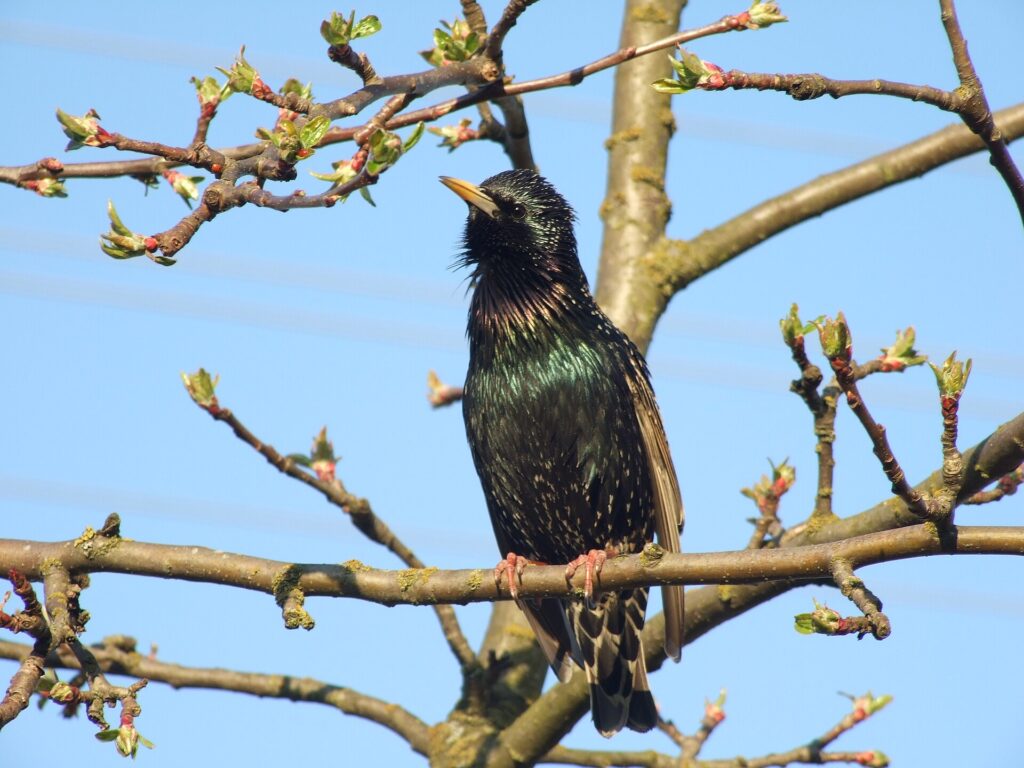
5. European Starling — The Bird Doing Several Other Birds
Starlings look black from a distance, but fresh plumage can show iridescent greens and purples with pale spotting.
They have short tails, pointed wings and long pointed bills.
They are also accomplished vocal mimics, so a strange whistle or mechanical noise in an urban park may be a starling making birding unnecessarily interactive.
6. Common Grackle — The Large Black Bird That Is Not a Crow
Common Grackles are long-tailed, long-billed birds with glossy dark plumage. Males can show strong purple, blue or bronze iridescence.
They are slimmer than crows and often gather on lawns, fields and parking lots.
Their pale eyes give them the expression of someone recently informed of a problem in accounting.
7. Brown-headed Cowbird — The Bird With the Literal Name
Adult male Brown-headed Cowbirds are glossy dark birds with distinctly brown heads. Females are plain gray-brown.
Cowbirds are brood parasites: females lay eggs in nests of other bird species, leaving the hosts to raise the young.
This is one of the first bird facts that sounds invented and is not.
8. Mourning Dove — The Sad Owl Noise at Noon
Mourning Doves are slim warm-gray birds with small heads, pointed tails and dark spots on the wings.
Their soft cooing is often mistaken for an owl until you connect the sound with the dove sitting openly on a wire.
Once you learn the long pointed tail, they become difficult to unsee.
9. Northern Mockingbird — Gray Bird With Excessive Material
Northern Mockingbirds are gray and white, long-tailed birds famous for learning and repeating many sounds.
Large white patches flash in the wings during flight.
If one bird on a roofline appears to be performing an entire neighborhood soundscape, the mockingbird may have taken the shift.
10. Gray Catbird — The Bird That Says “Cat”
Gray Catbirds are nearly uniform slate gray, with a black cap and a rusty patch under the tail that is often difficult to see.
Their beginner-friendly feature is the nasal mew that inspired the name.
The identification sequence can genuinely be:
cat sound,
bush,
bird.
Natural history occasionally gives you something easy.
11. Cedar Waxwing — The Bird That Looks Professionally Designed
Cedar Waxwings have smooth tan-brown plumage, a crest, black mask, gray wings and a yellow-tipped tail. Some show small red waxlike tips on the wing feathers.
They often arrive in flocks around fruiting trees.
They look like someone designed a bird logo for a premium outdoor hotel.
12. Red-winged Blackbird — Especially the Female You Called a Sparrow
Male Red-winged Blackbirds are easy: black body, bright red-and-yellow shoulder patches.
Females are brown, heavily streaked and often mistaken for large sparrows by beginners.
Wetlands, cattails and roadside marshes are good places to meet both versions and learn why male field marks are not enough.
13. Female Mallard — The Duck That Became “Just a Duck”
Male Mallards have the famous green head.
Females are mottled brown, with an orange-and-brown bill and, when visible, a blue wing speculum bordered in white.
A pond full of differently colored ducks is not necessarily a pond full of different species.
Sometimes one species is making identification unnecessarily gendered.
14. Killdeer — The Shorebird in the Grocery-Store Parking Lot
Killdeer are plovers with two dark breast bands, brown backs, white underparts and a loud repeated kill-deer call.
Despite being shorebirds, they commonly use gravel lots, athletic fields and other open ground well away from water.
The long-legged bird yelling in the parking lot may not be lost.
It may be exactly where it intended to be.
Learn the Birds Where You Live
Start with shape, habitat and behavior before obsessing over tiny feather marks.
Is it hopping on the ground or climbing a trunk? Is the bill thin or thick? Is the tail long? Is it in reeds, pavement, a feeder or open water?
Then add sound.
One day the background category called birds breaks into twenty recognizable neighbors.
That is also the moment you begin noticing the hundreds you still cannot identify.
The hobby has you.
Related: Ten Birds to Notice in the Canadian Rockies · 10 Birds Whose Calls Sound Nothing Like Birds · An Interview With a Bird That Declined Identification
Leave a Reply