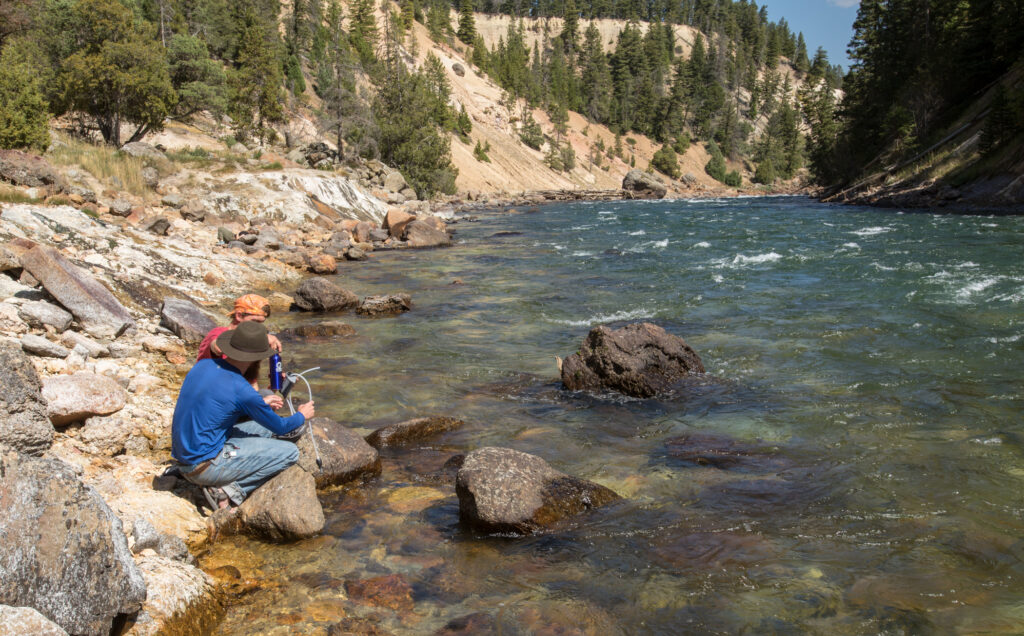
There is a particular moment in backpacking when a clear mountain stream stops looking like water and starts looking like a microbiology problem.
This is progress.
Portable water treatment falls into several categories: squeeze filters, bottle filters, straws, gravity systems, pumps, and purifiers. The crucial distinction is that many common backpacking filters are designed to remove bacteria and protozoa but not viruses. Some purifiers are designed to address viruses too.
That matters more than how aggressively the product page photographs a waterfall.
Here are ten current ways to become extremely specific about what is living in the creek.
1. Sawyer Squeeze — The Backpacking Default for a Reason
The Sawyer Squeeze uses a 0.1-micron absolute hollow-fiber membrane. Sawyer says the filter itself weighs about 3 ounces and removes bacteria and protozoa including Giardia and Cryptosporidium, along with microplastics.
It screws directly onto the included pouches and common 28mm-thread bottles, which is one reason it has become such a common trail system.
The other reason is that the filter can be backwashed repeatedly rather than treated as a disposable cartridge.
It does not remove viruses.
For much of ordinary backcountry North America, a bacteria-and-protozoa filter may be appropriate depending on the water source and local guidance. For travel or locations with different contamination risks, that assumption deserves another look.
The creek has now successfully turned you into someone who says “0.1 micron absolute.”
2. Platypus QuickDraw — The Tiny Filter With Bottle Opinions
The current QuickDraw weighs about 2.9 ounces total and uses a 0.2-micron hollow-fiber filter. Platypus lists a claimed flow rate of 3 liters per minute, a 1,000-liter cartridge life, and compatibility with common 28mm plastic bottles as well as its own reservoirs.
It removes bacteria and protozoa, not viruses.
This is a useful alternative for hikers who like squeezing water directly through a small filter and want broad bottle compatibility.
Its great contribution to backpacking civilization is allowing a disposable-looking plastic bottle to become part of a highly considered water-treatment architecture.
3. Katadyn BeFree AC 1.0 L — The Bottle That Wants to Be Shaken
The current BeFree AC 1.0 L combines a flexible one-liter bottle, hollow-fiber filtration, and activated carbon. REI lists it at about 2.7 ounces with a flow rate around 2 liters per minute.
It removes bacteria and protozoa. The carbon component can also help with taste and certain chemicals, but this is still not a virus purifier.
The BeFree is especially pleasant for hikers who dislike the ritual of filling a separate dirty bag, attaching a filter, squeezing into another bottle, and discovering they have created a tiny wet factory beside the creek.
Fill. Drink. Continue walking.
Backpacking occasionally permits a system to be simple.
4. LifeStraw Peak Series Solo — The Bottle-Thread Minimalist
LifeStraw’s Peak Solo weighs about 1.7 ounces, screws onto standard 28mm bottles, and is rated by the manufacturer at up to 3 liters per minute.
Its 0.2-micron membrane filter removes bacteria, parasites, and microplastics. LifeStraw rates the filter life up to 2,000 liters.
Again: bacteria and parasites, yes. Viruses, no.
This is for people who want the smallest practical filter possible and are happy using ordinary bottles as the rest of the system.
The filter is tiny enough that forgetting it at the previous water source becomes a realistic new threat.
5. LifeStraw Peak Series Straw — The Emergency-Kit Classic Grows Up
The Peak Series personal straw weighs 2.3 ounces and is rated for up to 4,000 liters. It uses a 0.2-micron membrane and can drink directly from a source, connect to compatible bottles, or work with gravity hoses.
Direct-from-stream drinking is appealing because it eliminates almost everything except lying near water in a posture that suggests you have recently been tranquilized.
For emergency kits and day hikes, that simplicity is useful.
For backpacking, many people prefer treating water into a bottle so they do not have to return physically to the source every time they want a drink.
6. Platypus GravityWorks 4 L — Stop Squeezing and Let Physics Work
The GravityWorks 4-liter system weighs about 11.5 ounces and treats water using gravity rather than hand pressure.
Fill the dirty reservoir, hang it, connect the filter, and let water move into the clean reservoir.
This is much heavier than a two- or three-ounce squeeze filter. It is also much nicer when a group needs several liters at camp.
The GravityWorks removes bacteria and protozoa, not viruses.
For four people making dinner, “hang bag and do something else” can be more valuable than saving eight ounces.
Gravity has finally begun contributing to the trip.
7. Katadyn Gravity BeFree 3 L — Group Water Without the Full Plumbing Department
Katadyn’s 3-liter Gravity BeFree system currently weighs about 6.8 ounces and uses the BeFree hollow-fiber technology in a gravity format.
This sits between the tiny personal filters and larger camp systems.
It is useful for two people, small groups, or anyone who wants to fill a bag once and let water treatment proceed while camp happens.
The trade is packing a larger reservoir and hose arrangement instead of a tiny filter.
At some point every group backpacking trip becomes a question of whether one person is now officially in charge of utilities.
8. GRAYL GeoPress — The Bottle You Push Like a French Press
The GeoPress is a purifier rather than a basic backcountry microfilter.
GRAYL’s cartridge uses electroadsorption and activated carbon. The company states that it targets viruses as well as bacteria and protozoa, while also reducing particulates, odors, and a range of chemical contaminants. The 24-ounce system works by filling an outer cup and pressing the inner purifier through it.
This makes it heavier and bulkier than the ultralight squeeze-filter crowd.
Its strength is broader treatment for travel, questionable infrastructure, and situations where viruses are part of the concern.
Instead of squeezing a bag, you lean over a bottle and press with the posture of someone attempting CPR on a thermos.
9. MSR Guardian Purifier — The Expedition Pump
MSR’s Guardian is a serious pump purifier. The current model weighs about 1 pound 1.3 ounces, physically removes viruses, bacteria and protozoa, and has a rated output around 2.5 liters per minute.
MSR says the system uses part of each pump stroke to backflush itself, reducing manual cleaning.
This is not the obvious tool for an ultralight weekend in Wisconsin.
It makes much more sense for international travel, expedition use, remote groups, and conditions where virus removal and ruggedness justify carrying something more substantial.
A one-pound water purifier sounds heavy until your treatment requirements are no longer hypothetical.
10. LifeStraw Peak Series Gravity Purifier — The Camp Water Department
LifeStraw’s current Peak Series Gravity Purifier uses an 8-liter bag and a 0.02-micron ultrafilter. The company lists it at about 26.4 ounces and says it treats viruses, bacteria, parasites, and microplastics with a gravity-fed flow up to roughly 30 liters per hour.
This is not a solo backpacking filter.
It is a group-camping, basecamp, travel, or emergency-preparedness system where treating substantial amounts of water matters more than carrying minimal weight.
The 8-liter bag also means you can stop sending individual people down to the creek carrying assorted bottles like a small village before indoor plumbing.
The Important Part Is What the Filter Does Not Do
Portable treatment equipment is easiest to misunderstand when every product is called some version of “water filter.”
Read the actual treatment claim.
A common hollow-fiber backpacking filter may remove bacteria and protozoa but not viruses. Activated carbon may improve taste and reduce some chemicals without making an ordinary microfilter a virus purifier. A purifier may address broader biological risks but weigh and cost much more.
Also pay attention to freezing.
Once many hollow-fiber filters have been wetted, freezing can damage the fibers. Sawyer explicitly recommends replacing a used filter if you suspect it froze because there is no practical field test that proves the membrane remains intact.
So in freezing weather, the tiny filter may need to sleep with you.
You have gone from drinking out of a stream to protecting a three-ounce plastic object with your body heat.
This is still camping.
Related: 10 Hiking Pants to Shit Yourself In · 12 Camping Chairs for Sitting Down After Walking Somewhere to Sit Down · 9 Binoculars for Looking at a Bird That Will Leave Before You Focus Them



Leave a Reply