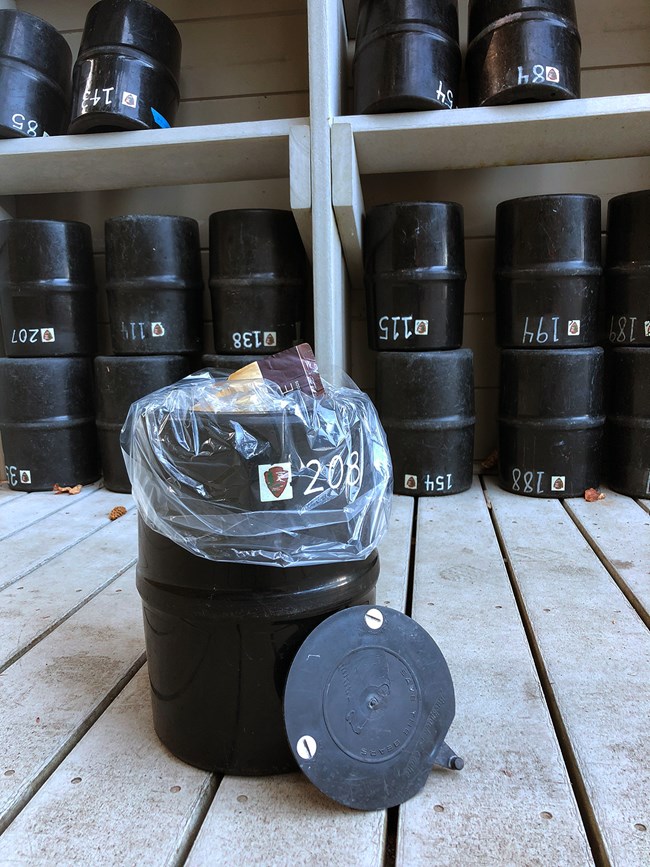
A bear canister is an expensive plastic or composite cylinder you carry into the backcountry so a bear cannot eat your tortillas.
This sounds excessive until you consider the alternative: a bear learns that backpacks contain tortillas.
Bear-resistant food storage is not just about protecting your lunch. Food-conditioned bears can become persistent around people, creating danger for visitors and often much worse consequences for the bear. In places such as Yosemite, approved containers are required in the wilderness, and the park’s definition of “food” includes garbage, toiletries, drinks, and other scented items.
One important phrase here is bear-resistant. Not bear-proof. Bears are highly motivated industrial-testing departments with paws.
Also important: approval varies by land manager. A canister accepted in one area may not satisfy another area’s rules. Check your exact destination.
With that established, here are eight legitimate current choices.
1. BearVault BV425 — The Weekend Cylinder
The BV425 is the small end of BearVault’s current hard-sided lineup and appears on Olympic and Denali’s approved-container lists.
Its appeal is straightforward: shorter trips and smaller food loads do not always require carrying a week-size barrel.
BearVault uses clear walls, a wide opening, and a screw-style lid that does not require a coin or screwdriver.
The transparency is more useful than it sounds. In an opaque canister, the snack you want is always underneath everything else because physics is vindictive.
2. BearVault BV450 — A Little More Room Before You Begin Sitting on the Lid
The BV450 is another longstanding approved BearVault model. It is larger than the 425 but still intended for shorter trips and modest food loads.
Like the other BearVaults, it can double as a camp stool if you enjoy seating yourself directly on the object containing every edible thing you own.
The real skill with any canister is packing.
Remove bulky packaging, use compact calorie-dense food, and accept that a bag of tortilla chips has no future in this environment.
3. BearVault BV475 — The Awkwardly Useful Middle Child
The BV475 sits between the shorter BearVaults and the full-size BV500. Current comparison data puts it around 565 cubic inches and roughly 36 ounces.
That makes it useful for someone who needs more than a weekend container but does not want the tallest full-size model.
This is a very specific problem.
Once you have researched enough bear cans to understand why 125 cubic inches matters, your transformation into a backpacker is complete.
4. BearVault BV500 — The Familiar Big Clear One
The BV500 is the classic large BearVault. The manufacturer lists it at 8.7 inches in diameter and 12.7 inches high, with an IGBC certification, and says it fits roughly seven days of food for one person.
It is currently approved on major lists including Yosemite, Olympic, and Denali.
It also makes a serviceable stool or tiny table.
This is convenient because the canister is already occupying approximately the same amount of psychological space in your pack as a kitchen appliance.
5. Garcia Backpackers’ Cache 812 — The Black Barrel From the Government Office
The Garcia Model 812 is a classic approved hard-sided canister. Yosemite currently rents this model at wilderness permit stations and lists it at about 10 liters, 2 pounds 11 ounces, 12 inches tall, and 8.8 inches in diameter.
Unlike the clear BearVault, it is opaque.
This produces a traditional backcountry game called “Where Is the Peanut Butter,” in which you remove six meals to discover the thing you need was touching the lid.
Its advantage is decades of use and wide recognition on approval lists.
6. Bare Boxer Contender 101 — Small, Dense, and Serious
The Bare Boxer Contender is a compact hard-sided canister appearing on current Yosemite, Olympic, Denali, and Shenandoah approved lists.
It is intended for shorter food carries and hikers who want a smaller container than the usual large cylinders.
Small volume requires discipline.
A bear canister does not care that the cookies came in a protective plastic tray. The tray is now your enemy.
7. Counter Assault Bear Keg — A Keg Nobody Wants to Tap
The Counter Assault Bear Keg is another approved model on current NPS lists. It is a larger hard-sided canister, and comparison data puts its weight well above lighter options.
The trade is obvious: capacity and proven approval versus carrying more container.
It is bright yellow, which makes it easier to find after you place it away from camp.
It also looks enough like hazardous industrial equipment that nobody will accidentally confuse it with cookware.
8. UDAP No-Fed-Bear — A Product Name That Is Also the Entire Assignment
UDAP’s No-Fed-Bear appears on current approved lists for parks including Yosemite and Shenandoah.
It is a traditional hard-sided design requiring secure closure and careful packing like the others.
The name is refreshingly direct.
A surprising amount of backpacking equipment marketing involves mountains, freedom, summits, and exploration. This product is named after the actual objective: do not feed bear.
The Container Is Only Part of the System
Buying an approved canister does not make your food storage correct automatically.
First, verify that your exact model is accepted where you are going.
Then put all required scented items inside. Yosemite, for example, includes food, drinks, garbage, and toiletries in its storage rules.
Follow local guidance on where to place the canister overnight. Shenandoah advises flat ground away from camp and warns against attaching ropes or straps that could give a bear something to carry.
And do not put the canister beside a cliff or river unless your trip plan includes watching your entire food supply roll away.
The best bear canister is not necessarily the lightest or largest. It is the approved one that fits your trip, fits your food, fits your pack, and actually gets used correctly.
The bear will not appreciate any of this.
That is the point.
Related: A Bear Locker Full of Questions · Black Bear Disappointed to Learn Subaru Contains Only Climbing Equipment · Bear Claims Tent Attack Was “Mostly Investigative”
Leave a Reply