A national monument can protect an enormous landscape.
It can also protect one cave.
One volcano.
One fossil deposit.
One prehistoric quarry.
One group of mammoth bones.
The 1906 Antiquities Act authorized presidents to proclaim national monuments on federal land to protect historic landmarks, structures and objects of historic or scientific interest. Congress has also established monuments through legislation.
The result is a wonderfully specific collection of answers to the question:
What exactly are we protecting here?
1. Devils Tower — This Exact Enormous Rock
Devils Tower became the first national monument under the Antiquities Act in 1906.
The proclamation described the tower as an extraordinary natural wonder of historic and scientific interest.
The protected object is refreshingly obvious.
You drive across northeastern Wyoming.
A giant fluted igneous monolith rises above the landscape.
The federal government’s response was essentially:
Yes. That.
Keep that.
The tower also has longstanding cultural significance to Indigenous peoples of the region, something the purely geologic story does not replace.
2. Dinosaur National Monument — The Dinosaur Bones in the Wall
Dinosaur National Monument began with an extraordinarily rich fossil deposit.
President Woodrow Wilson’s 1915 proclamation specifically referenced “Dinosaurian and other gigantic reptilian remains” of the Jurassic.
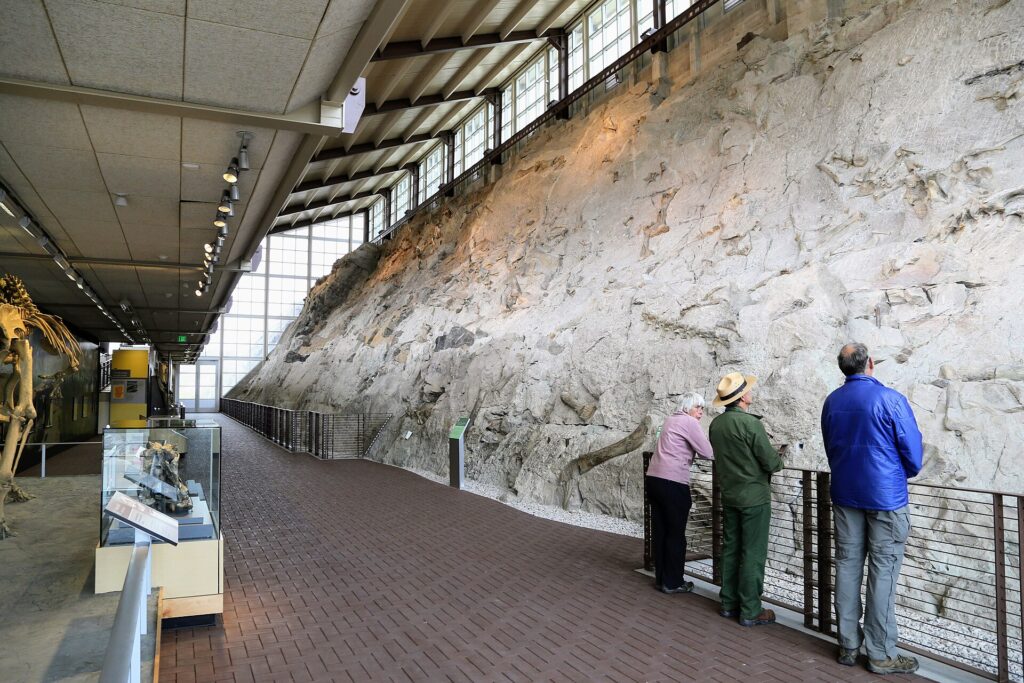
Today the Quarry Exhibit Hall encloses a rock face containing roughly 1,500 exposed dinosaur bones.
This may be the most literal national-monument concept available.
The fossils are not replicas arranged in a museum wall.
The wall is the fossil site.
Government successfully put a building around the thing.
3. Craters of the Moon — The Weird Lava Landscape
Craters of the Moon was proclaimed in 1924 to protect an extensive volcanic landscape in Idaho.
The proclamation called out fissure eruptions, cones, craters, rifts, lava flows, caves and natural bridges, describing the landscape as unusual and scientifically valuable.
This is unusually enthusiastic presidential geology.
The object was not one volcano.
It was an entire collection of volcanic consequences.
The name sounds lunar.
The legal reason was very terrestrial.
4. Florissant Fossil Beds — Tiny Insects and Giant Stumps
Florissant Fossil Beds in Colorado protects one of the world’s richest Eocene fossil deposits.
The site contains exceptionally detailed fossil insects, leaves, flowers and other organisms preserved in fine lake sediments.
It also preserves enormous petrified redwood stumps.
This combination is excellent.
A national monument can simultaneously care about a tiny fossilized insect wing and a tree stump you could hold a meeting around.
Scale is not part of the eligibility test.
Scientific importance is.
5. Waco Mammoth — One Catastrophic Mammoth Site
Waco Mammoth National Monument protects an extraordinary concentration of Columbian mammoth fossils in Texas.
NPS describes it as the largest known concentration of mammoths dying from the same event in North America and the first recorded nursery herd of Columbian mammoths in the country.
This is not a monument to mammoths generally.
It is a monument to these mammoths, here, in this deposit.
Paleontology depends on context.
Where the bones lie matters.
The hole is part of the information.
6. Capulin Volcano — One Extremely Legible Cinder Cone
Capulin Volcano National Monument protects a classic cinder cone in northeastern New Mexico.
The cone rises conspicuously above the surrounding plains, and visitors can drive around its rim and walk into the crater.
This is useful educational geology because the volcanic landform is visually clear.
You do not need a geology degree to understand:
There is the volcano.
There is the crater.
We have placed a road around the top.
Please enjoy volcanology responsibly.
7. Timpanogos Cave — Three Connected Caves Inside a Mountain
Timpanogos Cave National Monument in Utah protects an underground cave system reached by a steep trail.
The monument includes Hansen Cave, Middle Cave and Timpanogos Cave, connected for tours.
The caves contain decorated formations produced by mineral deposition over long periods.
This is a national monument whose significant object cannot be appreciated from the highway.
You first climb the mountain.
Then you enter the mountain.
The important landscape is inside.
8. Alibates Flint Quarries — Stone With Thousands of Years of Human History
Alibates Flint Quarries National Monument in Texas protects quarry sites where Indigenous peoples obtained high-quality, brightly colored flint for tools.
The material was traded widely across the Great Plains.
This is not merely “a place with nice rock.”
It is a cultural landscape tied to thousands of years of human activity.
The quarries preserve evidence of technology, trade and long-term Indigenous relationships with the region.
The object of importance is both material and human.
Do not separate the stone from the people who used it.
9. Pipestone — A Quarry That Is Still Culturally Significant
Pipestone National Monument in Minnesota protects culturally important pipestone quarries.
Indigenous peoples have quarried the soft red stone for pipe-making for generations, and the site remains culturally and spiritually important.
This is not an abandoned archaeological curiosity.
It is a living cultural landscape.
That distinction matters.
A list about oddly specific monuments can be funny about government categories.
It should not be funny about Indigenous sacred traditions.
Some specificity deserves plain language.
10. Effigy Mounds — Earthworks Shaped Like Animals
Effigy Mounds National Monument in Iowa protects hundreds of Indigenous mounds, including earthworks shaped like animals such as bears and birds.
The mounds are cultural sites, burial places and sacred landscapes connected to Indigenous peoples past and present.
The reason for protection is indeed specific.
The subject, however, is not quirky.
It is human history and living cultural significance.
The monument exists because shaped earth itself can be architecture, archaeology, memory and sacred space.
A national monument does not need a stone building to contain something built.
National Monument Is a Protection Tool, Not a Theme
“National monument” does not describe one type of place.
It describes a designation.
That is why the category can contain:
- volcanic fields;
- fossil beds;
- caves;
- quarries;
- archaeological landscapes;
- giant rocks;
- historic structures;
- large ecosystems.
Sometimes the protected object is physically enormous.
Sometimes it is tiny.
Sometimes it is not really an “object” in the everyday sense at all.
The genius of the category is that the government can become extremely specific.
A dinosaur deposit matters.
A cave matters.
A quarry matters.
A rock formation matters.
A culturally significant landscape matters.
The sentence does not have to end with “and therefore build a giant park around everything nearby.”
Sometimes it ends with:
Protect this exact thing.
Related: 11 National Parks Where the Parking Lot Is Now the First Hike · 13 Things Rangers Would Like You to Stop Doing Immediately · Counting the National Park Parking Lot

Leave a Reply