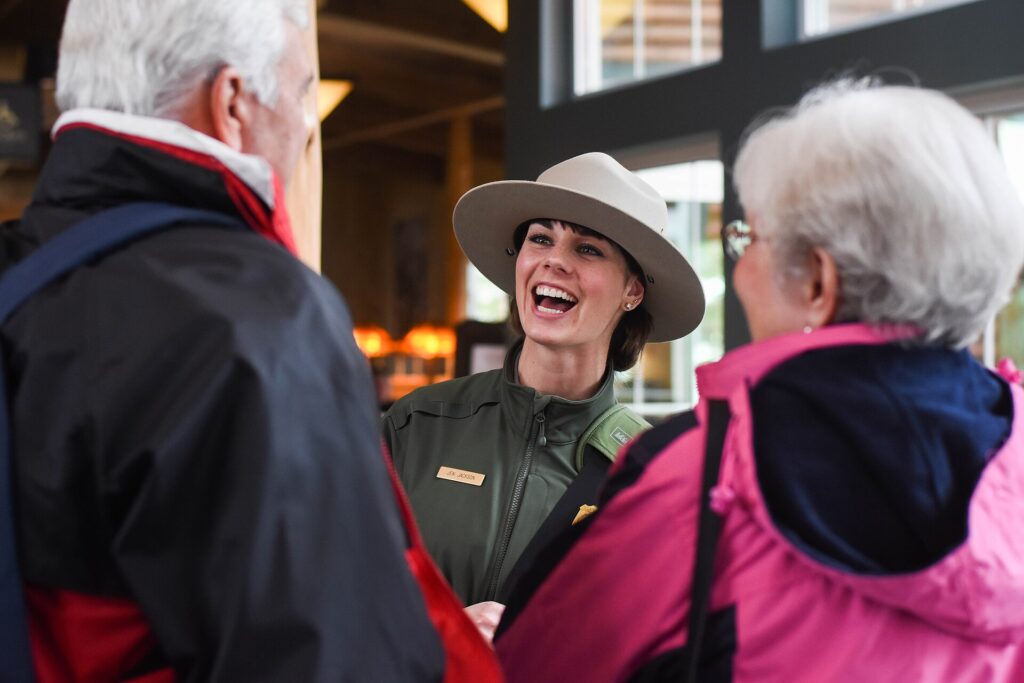
Park rangers have many jobs.
Resource protection. Search and rescue. Law enforcement. Interpretation. Wildlife management. Fire response. Visitor services. Maintenance coordination. Emergency medicine.
They also spend a statistically alarming amount of time explaining that the bison does not want a selfie.
National parks are not theme parks with unusually realistic animals.
They are protected places with rules built around keeping people, wildlife, cultural resources and landscapes intact.
Here are thirteen ways visitors make that work harder than necessary.
1. Feeding Wildlife
Do not feed wildlife.
Not squirrels.
Not chipmunks.
Not ravens.
Not the deer standing nearby with the facial expression of someone who has learned this works.
Human food can alter natural behavior, cause animals to approach people, create conflict, damage health and lead to animals becoming aggressive or dependent.
NPS prohibits feeding wildlife.
The squirrel is not starving.
It is conducting a successful customer-acquisition campaign.
2. Walking Toward Wildlife for a Better Photograph
Wildlife-distance rules vary by park and species.
The principle does not.
Give animals room.
Yellowstone requires at least 25 yards from bison, elk and most other large animals, and 100 yards from bears, wolves and cougars.
If the animal changes behavior because of your approach, back up.
There is already a technology designed to make distant objects look closer.
It is called a lens.
3. Stopping the Car in the Middle of the Road Because Elk Exist
Wildlife jams are part of the experience at many parks.
That does not make the center of the roadway a parking space.
Pull over only where legal and safe.
Follow ranger directions.
Do not abandon a vehicle partly in traffic because an animal has become visible.
The elk is not hosting an event.
Traffic laws remain active.
4. Leaving Food Out Because You Will “Only Be Gone a Minute”
A minute is sufficient for a raven, squirrel, raccoon or bear to begin a project.
Food-storage rules differ by park, but many parks require strict storage in vehicles, lockers or approved bear-resistant containers.
“Scented items” may include toothpaste, trash, coolers and toiletries, not just obvious food.
The animal does not understand that the granola bar was reserved for later.
It understands unattended granola.
5. Bringing the Dog Somewhere Dogs Are Not Allowed
Pet rules vary dramatically by park.
Many national parks restrict pets from trails, backcountry areas, buildings and shuttle systems.
Some allow them only in developed areas, campgrounds or roads.
Check the actual park rules.
The phrase “but he’s friendly” does not modify federal regulation.
It also does not modify wildlife behavior.
6. Playing Animal Calls to Make Something Appear
NPS wildlife guidance discourages using calls or sounds to lure animals closer.
This is especially relevant in birding, where playback can disturb territorial or breeding behavior.
The goal of wildlife watching is to observe what the animal is doing.
If you have made the animal stop doing that and come investigate your phone, the observation has become an intervention.
Leave the owl alone.
It is at work.
7. Flying the Drone Because the View Would Be Incredible
Launching, landing or operating drones is prohibited in most National Park Service lands unless specifically authorized.
This rule protects visitors, wildlife, soundscapes and park operations.
A wilderness overlook does not become improved because a small angry lawnmower is hovering over it.
There are many beautiful aerial photographs already available.
You can survive owning none of them.
8. Carving Your Name Into a Tree or Rock
Do not carve, scratch, paint or otherwise sign the landscape.
Natural and cultural resources in parks are protected.
Your initials are not the missing historical layer.
A tree does not become more meaningful because “J + M” visited in 2026.
The relationship can remain undocumented by bark.
9. Taking the Rock Home
Rocks, plants, fossils, cultural objects and other resources are generally protected from removal in national parks, subject to specific local exceptions.
If everyone takes one “small” object, the place changes.
This is particularly serious for archaeological artifacts and fossils, where location itself is part of the scientific and cultural information.
The rock is already home.
You are the traveler.
10. Building Random Cairns
Official cairns can be legitimate route markers in some places.
Random visitor-built cairns are different.
They can confuse navigation, disturb soil and habitat, and visually alter natural landscapes.
Some parks explicitly tell visitors not to build them.
Stacking rocks is pleasant.
Do it somewhere it does not impersonate trail infrastructure.
11. Leaving Food Scraps Because “It’s Biodegradable”
Orange peels, apple cores, bread, sunflower shells and other food waste are still litter.
They can attract wildlife, introduce nonnative seeds, and persist longer than visitors imagine.
Pack them out.
The banana peel does not become part of the ecosystem because you threw it dramatically into ferns.
It becomes a banana peel in ferns.
12. Walking Off Trail on Fragile Ground
Off-trail travel rules vary by park and ecosystem.
In some landscapes, stepping off the trail is perfectly legal and appropriate.
In others—cryptobiotic desert soils, alpine vegetation, thermal areas, restoration zones—it can cause serious damage or physical danger.
Obey closures and stay on designated surfaces where required.
Especially around geothermal features.
The boardwalk is not there because the ranger lacks imagination.
13. Inventing a Parking Space
Road shoulders, vegetation, restoration areas and trail edges are not automatically parking because other spaces are full.
Popular parks increasingly use shuttles, reservations, parking tags and traffic controls because vehicle demand exceeds what many destinations can absorb.
A full lot means the lot is full.
Driving onto grass does not reveal a secret fourteenth space.
It reveals why the ranger is tired.
Rangers Also Want You to Have a Good Time
Rules can look fussy when read as a list.
Most make more sense when you ask what problem they are preventing:
- wildlife conflict;
- damaged habitat;
- traffic accidents;
- lost artifacts;
- fire;
- noise;
- dangerous approaches;
- trashed campsites.
The ideal ranger interaction is often very short.
“Beautiful day.”
“Trail’s that way.”
“Thanks.”
No one mentions the squirrel eating your Cheetos because the squirrel is not eating your Cheetos.
An entire federal workforce is grateful.
Related: 11 National Parks Where the Parking Lot Is Now the First Hike · 10 National Monuments With Surprisingly Specific Reasons for Existing · Counting the National Park Parking Lot
Leave a Reply