Most animals do not want to ruin your weekend.
This is important.
The moose is not monitoring your vacation calendar. The rattlesnake has not read the reservation. The raccoon did not target you personally, even if the cooler evidence feels strong.
Wildlife conflict usually happens because humans get too close, store food badly, bring pets into a bad situation, fail to notice an animal, or interpret “wild” as a photography feature.
So this is not a ranking of murderous intent.
It is ten different ways an animal can alter the itinerary.
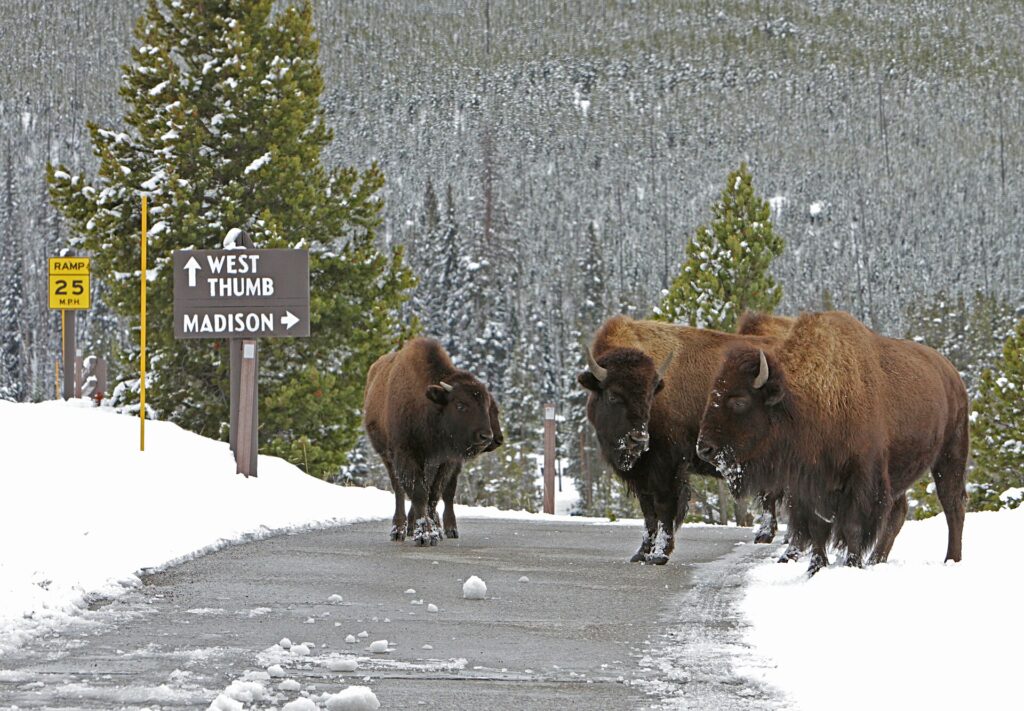
1. Bison — The Herbivore You Mistook for Scenery
Bison are North America’s largest land mammals.
They can also move much faster than their body shape suggests.
NPS repeatedly warns visitors to give bison substantial space; Yellowstone requires at least 25 yards.
The problem is familiarity.
A grazing bison looks calm, slow and photographable.
It is still a wild animal weighing hundreds or more than a thousand pounds.
If the bison changes your weekend, the bison was probably already occupying that part of the weekend before you walked toward it.
Use the zoom lens.
2. Moose — Built Like Furniture, Capable of Violence
Moose are enormous.
Large northern males can exceed 1,000 pounds, and NPS warns that moose can charge, kick and trample when threatened.
They are particularly worth respecting around calves, during rut, when dogs are present, or when an animal shows agitation.
A moose does not need antlers to create a serious problem.
The legs are enough.
Do not mistake ungainly proportions for lack of athletic ability.
A dining-room table cannot run.
A moose can.
3. Elk — The Park Animal Everyone Decides to Stand Near
Elk are common enough in some parks that visitors begin treating them as landscape furniture.
They are not.
During rut, bull elk can be especially dangerous. Cows can also defend calves.
Yellowstone’s general rule is at least 25 yards.
That is approximately 24 yards farther than the person holding a phone at arm’s length has planned.
If the animal is altering its behavior because of you, you are already too involved in the scene.
4. Bears — The Food Storage Exam
Black bears and grizzly/brown bears require different region-specific safety strategies, but one principle is universal: do not teach bears that people equal food.
Store food and scented items correctly.
Follow local bear-spray guidance where appropriate.
Give bears space.
Know what species live where you are traveling.
A bear getting your food does not merely ruin breakfast.
It can create a food-conditioned animal that becomes a recurring safety problem.
Your granola is not worth that.
5. Rattlesnakes — The Animal You Usually Notice After the Foot Goes Down
Rattlesnakes generally want to avoid people.
Conflict occurs when someone steps too close, reaches where they cannot see, handles the snake, or allows a dog to investigate.
Watch where you place hands and feet in snake habitat.
Do not attempt to move, pick up, photograph at intimate range, or otherwise convert the snake into a weekend project.
The rattle is not an invitation to begin filming vertically.
It is information.
Use it.
6. Alligators — The Pond Has Terms and Conditions
Alligators inhabit freshwater environments across parts of the Southeast.
Give them space and never feed them.
Feeding teaches alligators to associate people with food, which is bad for every party involved.
Pets are particularly vulnerable near water because they can resemble natural prey.
The alligator is not violating your waterfront expectations.
You entered alligator habitat and brought a Labradoodle.
Adjust accordingly.
7. Skunks — The Weekend Continues, but Differently
A skunk is unlikely to send you to the emergency room under normal circumstances.
It can still alter the entire social atmosphere of the trip.
Skunks typically warn before spraying: stamping, raising the tail, turning the body.
Back away.
Do not let a dog conduct further inquiry.
Tomato juice is not the magical universal solution people imagine; commercial odor neutralizers or peroxide-based cleaning formulas are generally more effective.
The larger lesson is simpler.
When an animal raises its tail and begins issuing warnings, believe the animal.
8. Raccoons — Your Food Storage Was a Suggestion
Raccoons are intelligent, dexterous opportunists.
In developed campgrounds they can become very skilled at exploiting coolers, bags, trash and unsecured food.
The physical danger from a normal raccoon encounter is not usually the main concern.
The concern is food loss, habituation, bites if cornered, and diseases including rabies in some regions.
Secure food.
Keep distance.
Do not feed the charming little hands.
Those hands are currently reviewing your latch design.
9. Porcupines — Your Dog Has Made a Tactical Error
North American porcupines do not shoot quills.
They do not need to.
Quills detach on contact and can become embedded in the skin of a dog or other animal that gets too close.
This can convert an ordinary camping trip into an emergency veterinary visit.
Keep dogs controlled.
Give porcupines room.
Do not attempt to “help” the situation by pulling a large number of quills without veterinary guidance.
The porcupine was moving slowly.
Your dog supplied the urgency.
10. Ticks — The Tiny Animal With the Long Administrative Tail
Ticks do not have the cinematic presence of bears or bison.
They can still cause the most annoying type of outdoor consequence: the medical follow-up that happens after the trip is over.
Different tick species can transmit different diseases, including Lyme disease in areas where infected blacklegged ticks occur.
Use repellents appropriately.
Treat clothing/gear when recommended.
Perform tick checks after being in brush, tall grass or leaf litter.
Remove attached ticks promptly with fine-tipped tweezers.
The smallest animal on this list is also the one most likely to make you fill out paperwork later.
The General Wildlife Strategy Is Boring and Effective
Give animals space.
Do not feed them.
Secure food.
Control pets.
Follow park-specific distance rules.
Carry bear spray where agencies recommend it and know how to use it.
Watch where you step.
Do not approach young animals.
Do not attempt to improve the photograph by becoming part of the photograph.
This advice lacks drama.
That is because the ideal wildlife encounter lacks drama.
You see the animal.
The animal continues being an animal.
Your weekend remains yours.
Related: 17 One-Star Reviews of Nature · 11 American Animals With Completely Unnecessary Names · 11 Animals That Are Much Larger Than You Thought They Were
Leave a Reply