Animal names are poor units of measurement.
“Pelican” sounds manageable.
“Salamander” sounds small.
“Turtle” does not prepare you for 1,000 pounds.
The problem becomes obvious when you see familiar animals at full scale.
Here are eleven North American species that become considerably more impressive once a measuring tape enters the conversation.
1. American Bison — Up to a Ton
Bison are the largest land mammals in North America.
NPS says large bulls can weigh up to about 2,000 pounds and stand around six feet tall at the shoulder.
This is not an unusually hairy cow.
It is a ton of wild herbivore capable of running roughly 35 miles per hour.
Photographs flatten scale.
The animal in the photograph is approximately the mass of a small car.
Remain farther away than the photograph suggests.
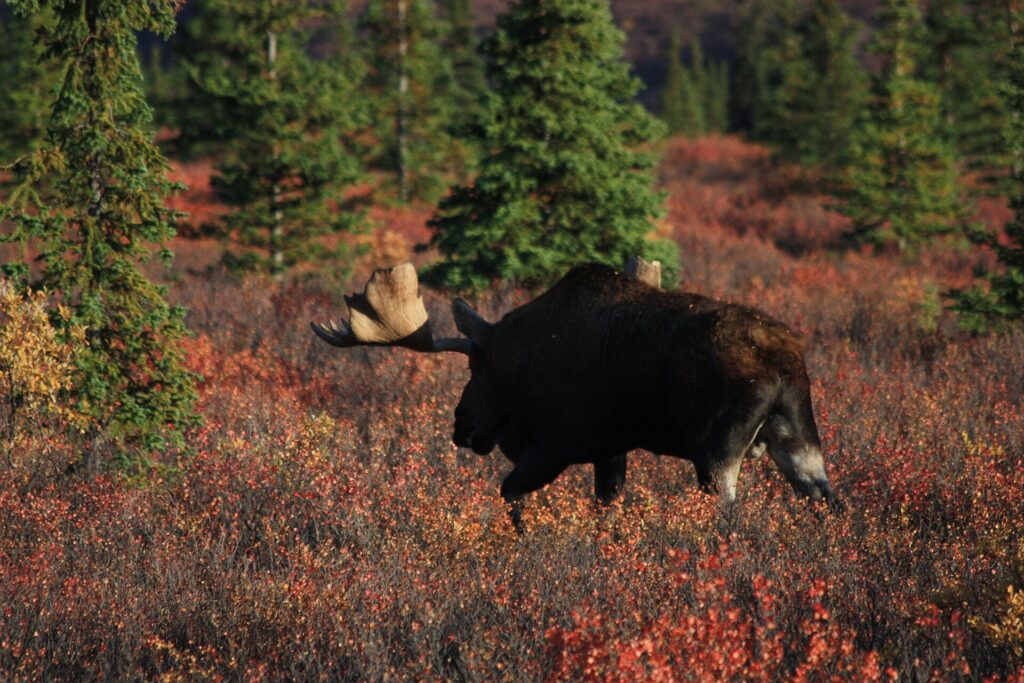
2. Alaska Moose — A Deer the Size of a Problem
Moose are the largest members of the deer family.
In Alaska, large adult males can stand six to seven feet at the shoulder and reach weights around 1,600 pounds.
Antlers can span several feet.
This is why calling a moose “a deer” feels technically correct and emotionally misleading.
A whitetail deer beside your road is wildlife.
A mature Alaska bull moose beside your road is temporary road management.
3. American Alligator — Fifteen Feet Is Possible, Not Normal
Typical alligators are smaller than the largest specimens.
USFWS notes that males have the potential to reach around 15 feet and roughly 500 pounds, while most are considerably smaller.
Other federal wildlife material notes exceptionally large alligators can exceed 1,000 pounds.
The important word is exceptionally.
Do not walk around imagining every six-foot alligator will become 1,000 pounds by dinner.
Still, the upper end of the species is enough reptile.
4. Leatherback Sea Turtle — A Turtle Measured in Hundreds of Pounds
NOAA lists typical adult leatherbacks around 750 to 1,000 pounds and five to six feet long.
Exceptional animals can be larger.
Leatherbacks are the world’s largest turtles and can occur in U.S. waters far north of tropical nesting beaches.
They do not have the hard shell people expect from a sea turtle. Instead the body is covered by tough rubbery skin over a flexible shell structure.
A turtle the weight of a grand piano has decided hard shell technology is unnecessary.
5. Alligator Snapping Turtle — The Freshwater Turtle With a 249-Pound Upper End
USFWS identifies the alligator snapping turtle as the largest freshwater turtle species in the United States.
Adult males can reach up to about 29 inches in shell length and 249 pounds.
Females are dramatically smaller, reaching around 62 pounds in the same federal description.
That sex difference matters.
“An alligator snapping turtle weighs 249 pounds” would be misleading.
“A very large male can” is accurate.
The animal remains enormous enough without help from bad phrasing.
6. California Condor — Nine and a Half Feet of Wings
California Condors have wingspans around 9.5 feet.
USFWS lists adults around 17 to 25 pounds.
That combination matters.
The bird is not enormously heavy compared with large mammals, but when the wings open the scale changes completely.
A nine-and-a-half-foot wingspan is wider than many rooms are tall.
A condor soaring overhead does not look like a bird enlarged slightly.
It looks like aircraft has become biological.
7. American White Pelican — Up to Nine and a Half Feet Across
American White Pelicans are among North America’s largest birds.
Cornell lists a wingspan range around 96 to 114 inches—up to roughly 9.5 feet.
They can weigh close to 20 pounds.
On water they can appear like oversized white ducks with extremely ambitious bills.
Then the wings open.
The bird occupies enough sky to require recalibration.
8. Whooping Crane — A Five-Foot Bird
Whooping Cranes stand about five feet tall and have wingspans exceeding seven feet.
They are among North America’s tallest birds.
Five feet sounds abstract until you realize the crane could look many adults approximately in the chest.
The bird is mostly legs, neck, wings and dignity.
There is no small version available.
9. Hellbender — Two Feet of Salamander
The hellbender is North America’s largest salamander.
USFWS says adults can exceed two feet in length.
That is not enormous in mammal terms.
It is enormous in salamander terms.
The animal is broad, flat, wrinkled and fully aquatic, spending much of its time beneath rocks in clean, fast-moving streams.
If your mental image of “salamander” fits comfortably on a leaf, please update the file.
10. North American Beaver — Sixty Pounds of Rodent Engineering
NPS lists adult North American beavers commonly around 35 to 60 pounds.
They are the continent’s largest rodents.
Again, photographs are deceptive.
A beaver swimming with only its head visible looks modest.
A 55-pound beaver walking on land looks like the concept of “rodent” has exceeded its design brief.
It also modifies hydrology.
Your hamster has accomplished very little.
11. Wild Turkey — Much More Bird Than Thanksgiving Clip Art Suggests
Adult male wild turkeys can exceed 20 pounds depending on region and individual.
A large gobbler on foot is tall, muscular-looking and considerably more substantial than the supermarket bird category suggests.
They can also fly.
Not for long cross-country migrations, but strongly enough to reach roosts and clear obstacles.
This is worth remembering before referring to wild turkeys as slow decorative poultry.
The bird has been living outside without assistance.
It has capabilities.
Why Maximum Size Can Mislead
Nature articles love maximum numbers.
Maximum numbers are fun.
They are also where accuracy goes to get injured.
A species may reach a certain weight without the average animal being remotely that large.
Sex matters.
Region matters.
Age matters.
Food availability matters.
For moose, Alaska produces some of the largest animals.
For alligator snapping turtles, large males are far heavier than females.
For leatherbacks, ordinary adults are huge even before exceptional records enter the story.
Use maximum size as an upper boundary, not an identity.
The better lesson is scale.
North America contains thousand-pound turtles, ten-foot wingspans, two-foot salamanders, sixty-pound rodents and deer taller than many humans.
You did not underestimate nature.
You underestimated the conversion from photographs to actual units.
Related: 17 One-Star Reviews of Nature · 10 Animals That Could Absolutely Ruin Your Weekend · 11 American Animals With Completely Unnecessary Names
Leave a Reply