Animals do not choose their common names.
This should be remembered before criticizing them.
Some biologist, hunter, settler, museum curator or exhausted committee looked at a perfectly good organism and produced a label containing colors, body parts, compass directions, behavior, geography and enough hyphens to qualify as a minor legal document.
The animal then had to live with it.
Here are eleven North American examples.
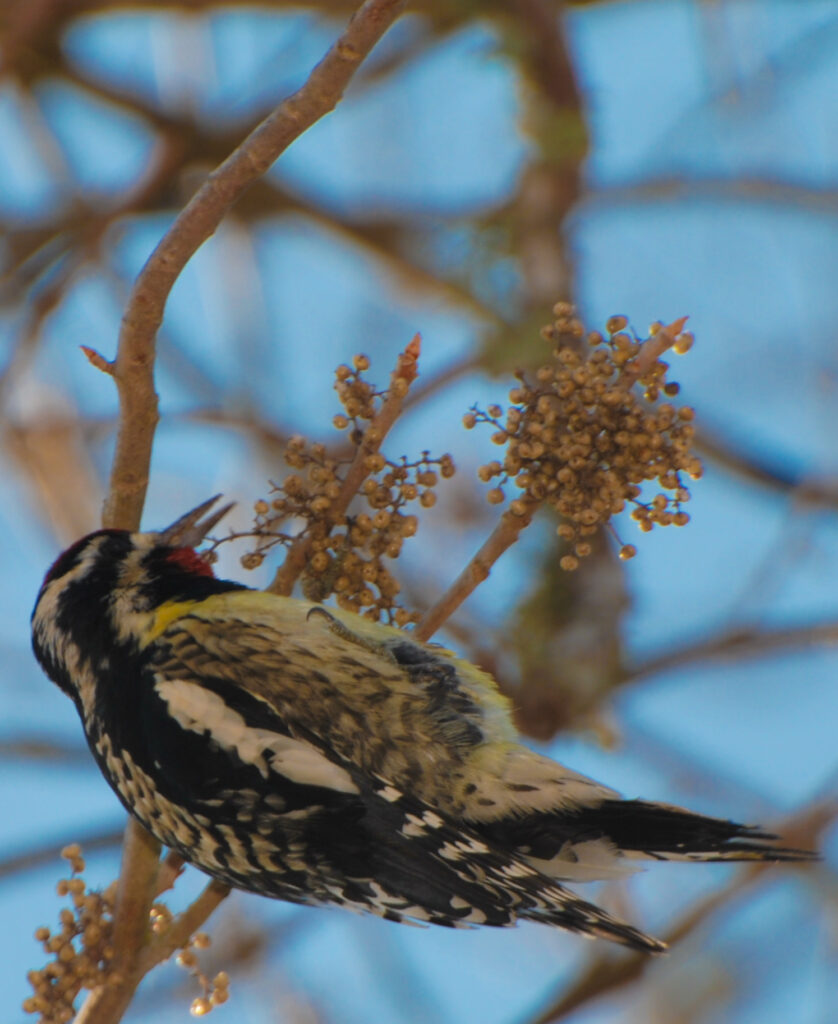
1. Yellow-bellied Sapsucker
This name sounds like an insult delivered by a prospector.
It is actually impressively literal.
The Yellow-bellied Sapsucker is a woodpecker that drills neat rows of shallow holes in trees and feeds on sap and trapped insects. Its underparts can show a yellowish wash.
So:
yellow-ish belly,
sap sucker.
The absurd name is innocent.
We simply stopped speaking like nineteenth-century field naturalists.
2. Red-bellied Woodpecker
The obvious problem is that the red on the bird’s belly is often difficult to see.
The red on the head is much easier.
Cornell explicitly notes that the namesake belly color is frequently obscured by surrounding feathers.
This means generations of beginners look at a bird with a bright red crown/nape and are told:
That is the red-bellied woodpecker.
Bird identification begins with trust exercises.
3. Ring-necked Duck
Do not look for the ring on the neck.
Cornell advises this directly.
The male Ring-necked Duck does have a chestnut collar on the black neck, but it is difficult to see in the field. The white ring around the bill is much more useful.
The name came from a feature that was obvious on dead specimens to the nineteenth-century biologists describing the species.
This is not ideal branding for living ducks.
4. Rough-legged Hawk
The legs are not emotionally difficult.
They are feathered.
Rough-legged Hawks have feathers extending down the legs toward the toes, an adaptation associated with their cold northern breeding range.
The name distinguishes them from many other hawks with bare lower legs.
Perfectly reasonable.
Still sounds like the bird has been hiking without lotion.
5. Black-crowned Night-Heron
We have now entered the compound-name department.
The adult bird has a black crown and back.
It is a heron.
It often forages in the evening and at night.
No individual word is unnecessary.
The total package sounds like a minor title from medieval government.
Black-crowned Night-Heron of the Western Marshes, Keeper of the Mudflat.
You would respect this office.
6. Red-cockaded Woodpecker
The “cockade” is a tiny red mark near the side of an adult male’s head.
It can be extremely difficult to see.
The species is much easier to identify using other plumage features, habitat and behavior.
This is another bird named for a field mark that feels almost deliberately unhelpful.
Naturalists looked at an entire woodpecker and selected the tiny ceremonial accent.
7. Thirteen-lined Ground Squirrel
You may count the lines.
The name invites it.
Thirteen-lined Ground Squirrels have alternating dark and light stripes/spotted lines down the back and are common in grasslands, lawns, parks and roadsides across much of central North America.
This animal got a name so specific that any squirrel with twelve visible lines should probably contact management.
There is a standard now.
8. Nine-banded Armadillo
Despite the name, individuals do not always display exactly nine movable bands.
The number can vary.
The name has nevertheless survived because “usually somewhere around nine-banded armadillo” is poor signage.
This is the familiar armadillo that has expanded northward through much of the southern United States.
The armored mammal is flexible.
The name is not.
9. Northern Short-tailed Shrew
This animal is:
northern,
has a relatively short tail,
and is a shrew.
Again, no fraud has occurred.
The Northern Short-tailed Shrew is a robust little insectivore famous for another trait that did not make the name: it produces venomous saliva that helps subdue prey.
Someone had the opportunity to call this the Venomous Forest Shrew.
Instead we documented tail proportions.
Science is restraint.
10. Long-tailed Weasel
Elsewhere in the naming department, the weasel was evaluated and management reached the opposite conclusion.
This one has a long tail.
The Long-tailed Weasel is a slender carnivore distributed widely across North America, often turning white in winter in colder parts of its range.
Its name is useful when distinguishing it from short-tailed relatives.
It is still a little funny that mustelid taxonomy can sound like a measuring contest.
11. White-footed Mouse
The White-footed Mouse has pale feet.
We did not overthink this one.
It is a common woodland and brushland mouse across much of eastern North America and can be difficult for casual observers to distinguish from similar deer mice.
The foot color contributes to identification.
After Black-crowned Night-Heron and Northern Short-tailed Shrew, White-footed Mouse feels almost minimalist.
Two adjectives were available.
Only one was used.
Editorial discipline.
Why Common Names Get Weird
Common names accumulate over time.
They may describe:
- a color;
- a body part;
- a location;
- a behavior;
- resemblance to another species;
- a field mark that made more sense to someone holding a museum specimen.
They are not a perfect scientific system.
That is what scientific names are for, and those have their own problems.
The useful response is not to demand that every animal receive a rebrand.
It is to enjoy the historical clutter.
“Yellow-bellied Sapsucker” sounds absurd until you meet the bird.
Then you discover that someone, at least once, knew exactly what they were talking about.
Related: 17 One-Star Reviews of Nature · 10 Animals That Could Absolutely Ruin Your Weekend · 11 Animals That Are Much Larger Than You Thought They Were
Leave a Reply