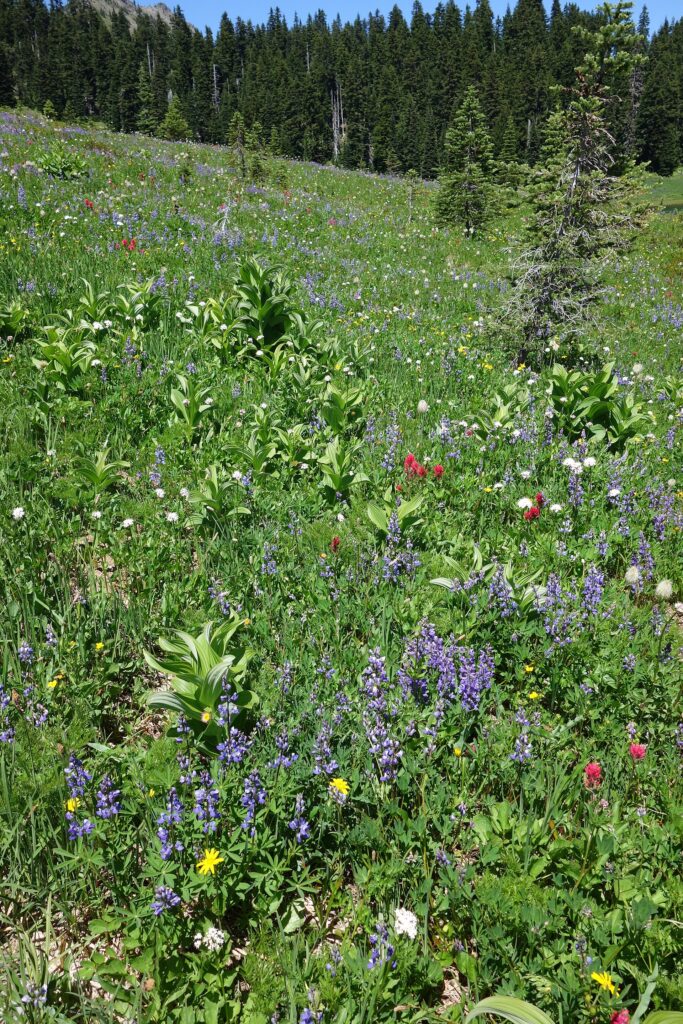
A wildflower is doing several jobs at once.
It is feeding pollinators, producing seed, storing energy, interacting with fungi, competing with neighbors, and trying to complete reproduction before weather, herbivores or drought interrupt the schedule.
You see the flower and think:
That would look nice in a cup holder.
Please reconsider.
In National Park Service units, picking wildflowers is prohibited. Elsewhere, laws and rules vary by land ownership and species. Even where picking is legal, some plants are slow-growing, locally uncommon, or especially vulnerable to repeated collection.
The easiest system is also the best one.
Look at the flower.
Photograph the flower.
Leave the flower functioning as a flower.
Here are nine good examples.
1. Trillium — Three Leaves, Three Petals, Several Years of Patience
Trilliums are iconic spring woodland flowers with their famous three-part structure.
Many species grow slowly and depend on underground rhizomes. Some take years to reach flowering size.
A picked blossom removes the current reproductive opportunity; damaging leaves can also reduce the plant’s ability to store energy.
This is a lot of biological consequence for a flower that will wilt before you get home.
Leave the trillium in the woods.
Your kitchen already contains objects.
2. Lady’s Slipper Orchids — The Forest Orchid Is Not a Souvenir
Native lady’s slipper orchids are among North America’s most recognizable wild orchids.
They can have specialized relationships with soil fungi and can be difficult or impossible to transplant successfully from the wild.
Some species or populations are uncommon or protected under state law.
Digging one up because it looks beautiful is an excellent way to convert a thriving orchid into a slowly dying orchid in your yard.
Admiration does not require possession.
This principle extends surprisingly far beyond botany.
3. Columbine — Built for Pollinators, Not the Dashboard
Columbines have long backward-pointing spurs that hold nectar and interact with pollinators including hummingbirds and insects depending on species.
Their strange geometry is not decorative excess.
It is reproductive equipment.
Wild populations contribute seed to future generations and food to pollinators.
The flower is already involved in a project.
You do not need to reassign it to centerpiece duty.
4. Lupine — The Whole Plant Is Doing Soil Work Too
Lupines are legumes.
Like many legumes, they associate with nitrogen-fixing bacteria, allowing them to contribute to nutrient cycles in relatively poor soils.
Their tall flower spikes can make a meadow look spectacular.
That visual abundance is exactly what tempts people to assume taking one does not matter.
In protected areas, it does.
And ecologically, the point of the meadow is that the flowers are in the meadow.
5. Indian Paintbrush — The Flower Is Borrowing From Its Neighbors
Paintbrushes in genus Castilleja are hemiparasitic.
They can photosynthesize, but their roots also connect with nearby host plants to obtain water and nutrients.
This is an excellent reason not to assume you can casually dig one up and relocate it.
The plant has existing relationships.
Your flowerpot is not on the network.
Also, much of what looks like a bright flower is actually colored bracts surrounding smaller true flowers.
The plant has already provided enough plot twists.
6. Bloodroot — Beautiful for About Five Minutes, Ecologically Interesting for Much Longer
Bloodroot is an early-spring woodland plant with white flowers and distinctive lobed leaves.
Its underground rhizome contains reddish sap that inspired the name.
The flowers can be short-lived and are part of the brief spring ephemeral season before the forest canopy fully leafs out.
Picking one gives you a rapidly fading white flower.
Leaving it gives the woodland a functioning native plant.
The second option has more staying power.
7. Trout Lily — A Flower Attached to an Underground Time Investment
Trout lilies can form colonies on rich woodland floors.
Their mottled leaves are easy to recognize, and the nodding yellow flowers appear in spring.
Young plants may spend years in vegetative growth before flowering.
A large colony can look inexhaustible.
That does not make the individual flowering plant disposable.
Forests are good at creating the illusion of abundance because they are not arranged around retail scarcity.
8. Prairie Smoke — The Flower Becomes Even Better if You Leave It Alone
Prairie smoke begins with nodding reddish flowers.
After flowering, the styles elongate into feathery plumes that create the smoky appearance behind the name.
If you pick the flower immediately, you miss the next phase.
This is an unusually direct argument for botanical patience.
The plant has a second act.
Do not take it home during intermission.
9. Penstemon — The Native Pollinator Bar
Penstemons include many western and North American species with tubular flowers used by bees, hummingbirds and other pollinators.
Different species occupy deserts, mountain slopes, grasslands and rocky areas.
Some are common.
Some are narrow endemics with very limited ranges.
This is why “it looks like there are plenty” is not a useful conservation assessment.
Unless you know the species, land rules and local population, leave the penstemon where it is.
The hummingbird has already made plans.
But What About Berries, Mushrooms and Other Things People Collect?
This is where rules become location-specific.
Some NPS units allow limited collection of certain fruits, berries, nuts or mushrooms for personal consumption under their Superintendent’s Compendium.
Others do not.
That exception does not convert flowers into collectibles.
For example, Saint Croix National Scenic Riverway allows limited quantities of specified fruits, berries, nuts and mushrooms while explicitly prohibiting wildflower collection.
Read the rules for the land you are actually visiting.
Public land is not one giant rulebook.
And remember that legality is only part of the question.
A thing can be legal to take and still be more interesting where it is.
The flower already has a vase.
It is called the ground.
Related: 12 Trees You Keep Calling a Pine Tree · Quaking Aspen Is One Giant Tree Pretending to Be a Forest · The Bristlecone Pine Has Been Standing Here Since Before Most of Our Problems
Leave a Reply