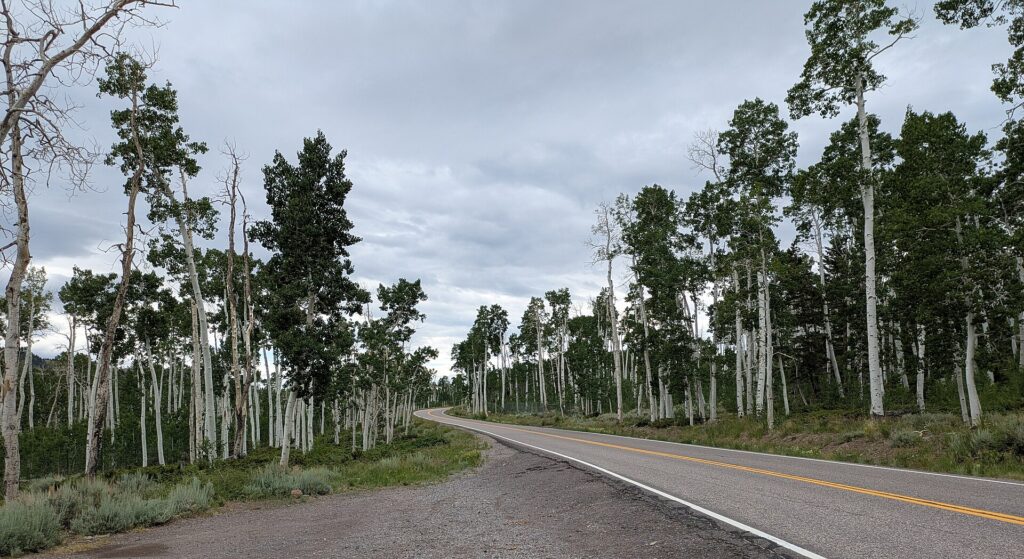
The first problem is the word tree.
You walk into an aspen grove and see hundreds or thousands of pale trunks.
Reasonable conclusion:
Those are trees.
Also reasonable:
Maybe.
Quaking aspens reproduce in two different ways.
They can grow from seed like ordinary respectable plants.
They can also send up new stems from a shared underground root system.
When that happens, what looks like a forest may be one genetic individual occupying many bodies above ground.
This is how we arrive at Pando.
A Tree Above, a System Below
Each visible aspen trunk is called a ramet.
The underground clone is the genet.
A trunk may live for decades.
The root system can persist much longer by continually producing replacement stems.
This means asking “how old is that aspen?” requires clarifying which aspen you mean.
The trunk?
The root system?
The genetic individual?
Botany has taken a basic birthday question and introduced ontology.
Pando Is Real
Pando is a giant quaking-aspen clone in Utah’s Fishlake National Forest.
DNA work by the U.S. Forest Service genetics laboratory and Utah State University confirmed that the enormous stand is a single genetic entity.
It covers more than 100 acres and contains tens of thousands of trunks.
This is why Pando is often described as one of the world’s largest organisms by mass or area.
The exact superlative depends on how “organism” and “largest” are being measured, which is the sort of argument Pando inevitably creates.
The important part is not the record.
The important part is that an entire hillside can be one plant repeatedly emerging from the ground.
Do Not Say It Is 80,000 Years Old
This is where the story often goes off the rails.
Popular accounts have assigned Pando astonishing ages—tens of thousands of years, sometimes much more.
Utah State University’s Western Aspen Alliance is explicit about the problem.
We do not have a reliable data-based age for Pando.
Scientists know it may be thousands of years old.
Anything much more precise requires assumptions about growth, climate history, clone expansion and survival that are difficult to verify.
This is a useful rule for ancient-organism stories:
If the age is impossibly satisfying, check how it was measured.
Pando does not need an invented birthday.
Being one giant plant is enough.
The Leaves Actually Quake
Quaking aspen gets its common name from the movement of the leaves.
The leaf stalks are flattened rather than round.
This allows the leaves to twist and flutter easily in wind.
A whole stand can shimmer with relatively little breeze.
The effect is visual and audible.
Aspen leaves create a soft flickering sound unlike the broader movement of many other tree canopies.
If the grove is one clone, there is something especially strange about watching thousands of genetically identical leaves shaking independently.
One organism.
Very poor synchronization.
Fire Is Not Always the Enemy
Aspens are often associated with disturbance.
Fire can kill aboveground stems while leaving portions of the underground root system alive.
The surviving roots can then produce large numbers of new shoots.
This ability allows aspen to respond rapidly after some fires and other disturbances.
That does not mean every fire is harmless.
Intensity, frequency, drought and post-fire browsing all matter.
But the basic strategy is different from that of a tree that depends entirely on surviving as one trunk.
An aspen clone can lose the visible forest and remain alive below.
The landscape appears destroyed.
The plant may already be preparing several thousand replacements.
The Elk Problem
Pando’s current challenge is not simply age.
It is regeneration.
If new shoots are repeatedly eaten before they grow into mature stems, the clone can lose the next generation of trunks even if the roots remain alive.
Researchers have focused especially on browsing by deer and elk.
Fencing, wildlife management and restoration experiments have attempted to allow young stems to escape browsing pressure.
This is an important distinction.
A giant old organism does not necessarily die through one dramatic event.
It can decline because replacement stops working.
The roots survive.
The canopy ages.
Young stems are eaten.
Eventually the visual forest becomes thinner.
Immortality has maintenance requirements.
Clones Are Not All That Aspen Does
Quaking aspen can also reproduce sexually from seed.
This matters because popular writing sometimes describes clonal reproduction as if it replaced ordinary plant reproduction entirely.
It does not.
Seed establishment is less conspicuous and depends strongly on moisture and disturbance conditions, but it contributes genetic diversity and allows aspens to establish new clones.
A clone spreads an existing genome.
A seed creates a new one.
Both strategies matter.
The forest is simultaneously repeating itself and experimenting.
One Forest, Many Seasons
Aspen clones can sometimes reveal themselves visually in autumn.
Stems belonging to the same clone may change color around the same time because they share genetics.
Neighboring clones may shift at different times or produce different shades.
This is not a perfect field method for identifying genetic boundaries.
Environment also affects color.
But it can provide a glimpse of the hidden structure.
What looked like one forest may contain several biological individuals.
What looked like several thousand trees may be one.
The aboveground landscape and the genetic landscape do not align neatly.
This is one reason plants are so good at quietly breaking categories.
The Forest Is an Organism, Except When It Isn’t
Pando invites grand statements.
“One tree the size of a forest.”
“One of Earth’s oldest organisms.”
“The world’s largest living thing.”
Some are useful.
Some need footnotes.
The more interesting lesson is not the record.
It is that individuality in plants is different from individuality in animals.
A wolf is one body.
An elk is one body.
An aspen can be thousands of trunks connected underground.
A visible stem can die without killing the organism.
New stems can appear yards away.
A grove can expand, retreat, fragment and regenerate while remaining genetically one thing.
You can stand among hundreds of white trunks and think you are surrounded.
Technically, you may be standing next to the same plant over and over again.
Related: Why Joshua Trees Look Like That · 12 Trees You Keep Calling a Pine Tree · 10 Hammocks for Sleeping Terribly Between Two Trees
Leave a Reply