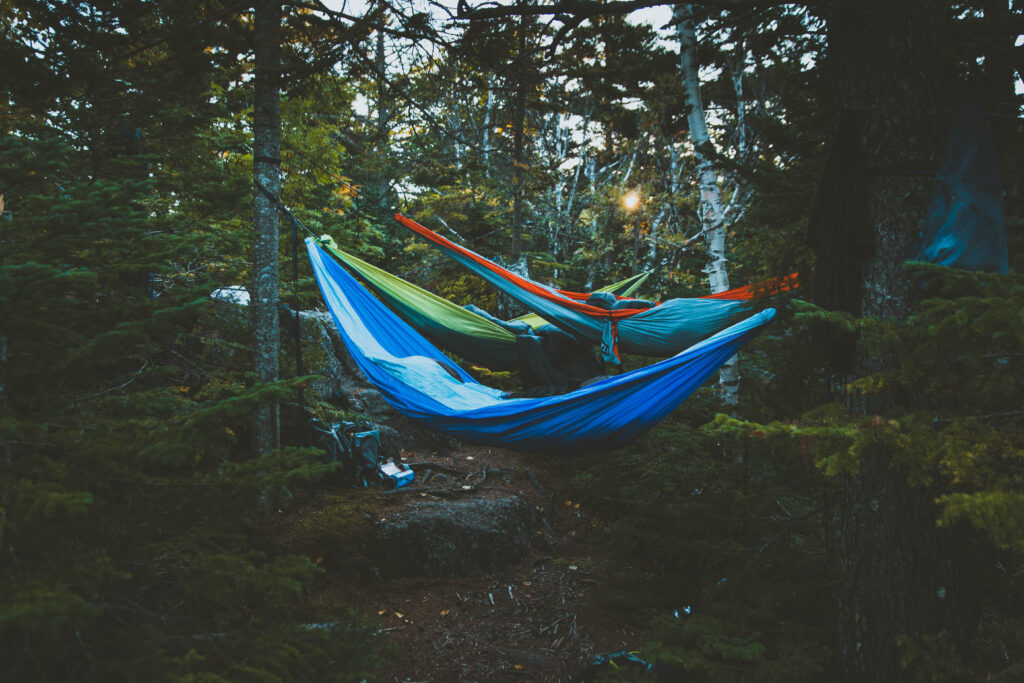
Beds have spent centuries solving a straightforward engineering problem: provide a relatively flat surface.
Hammocks looked at this achievement and asked whether the surface could instead be curved, suspended, moving slightly, dependent on two correctly spaced trees, and capable of teaching a person several new knots.
People love them.
This is not irrational. A good hammock can be wonderfully comfortable, compact, cool in warm weather, and useful on uneven ground. A complete hammock camping system can also replace a tent in the right terrain.
But the category contains everything from seventeen-ounce lounging hammocks to three-pound shelters with bug nets and rainflies.
Here are ten current versions of sleeping or sitting in the air.
1. ENO SingleNest — One Person, One Fabric Banana
The SingleNest weighs about 1 pound, supports up to 400 pounds, and measures roughly 114 by 58 inches unfolded.
This is the basic recreational hammock: day trips, campsites, backyards, festivals, and casual lounging.
Suspension straps are a separate consideration, as they are with many simple hammocks.
It is technically possible to sleep overnight in a simple gathered-end hammock.
It is also technically possible to sleep in a chair.
Your body will eventually submit a review.
2. ENO DoubleNest — More Fabric, Same Trees
The DoubleNest is ENO’s classic larger model, around 1 pound 3 ounces with a 400-pound capacity and dimensions around 114 by 76 inches.
The name suggests two people, and two people can lounge in it.
Sleeping is another matter. Many hammock campers prefer using the extra width alone so they can lie diagonally and flatten the body position somewhat.
This means the “double” hammock has achieved the same fate as the two-person tent: frequently occupied by one adult and all the adult’s things.
3. Kammok Roo Double — Wider, 500-Pound Capacity
The current Roo Double weighs about 17.1 ounces, measures 120 inches long, and carries a 500-pound maximum capacity.
Kammok includes its carabiner/sling hardware, but the tree straps are separate.
The manufacturer recommends it for one-person sleeping even though it can support two people while lounging.
This is an important distinction.
The structural capacity of a hammock and the romantic wisdom of sleeping two adults in one suspended nylon trough are different measurements.
4. ENO TravelNest + Straps — One Box, Fewer Missing Parts
The TravelNest bundle weighs about 1 pound 12 ounces, supports 400 pounds, and includes the straps needed to hang it.
That inclusion matters for first-time buyers because many hammocks are sold separately from the thing that actually attaches them to trees.
Buying a hammock without straps is a small outdoor rite of passage.
You arrive at the campsite with an object whose entire purpose is suspension and no legal way to suspend it.
The TravelNest avoids that moment.
5. ENO DayLoft — The Hammock Has Become Patio Furniture
The DayLoft weighs more than 10 pounds and measures roughly 118 by 44 inches.
It uses a structured spreader-style design rather than behaving like the tiny packable hammocks above.
This is for basecamp, patios, cabins, car camping, and other circumstances in which nobody is calculating ounces.
It is also a useful reminder that “hammock” is now a category broad enough to include both ultralight fabric sacks and furniture.
One goes in your backpack.
The other deserves a loading plan.
6. Hennessy Expedition Asym Zip — The Hammock Becomes a Shelter
The Expedition Asym Zip is a complete overnight hammock system. It has an integrated bug net, included rainfly, asymmetric sleeping shape, support ropes, and protective webbing straps.
Hennessy lists a 250-pound weight limit, fit up to about 6 feet tall, and a packed hammock weight around 2 pounds 12 ounces before the separate webbing straps.
This is no longer something you casually throw between trees for lunch.
It is a tent that has rejected the ground.
For wet or uneven forested camps, that can be an excellent arrangement.
7. Hennessy Ultralite Backpacker Asym Zip — The Shelter Goes on a Diet
The Ultralite Backpacker Asym Zip uses lighter fabrics and retains Hennessy’s integrated bug net and rainfly system.
Its purpose is to get the complete hammock-shelter idea closer to backpacking weights.
This is the version for someone who has already decided they sleep well in a hammock and now wants the rest of the system optimized around that decision.
That sequence matters.
Buying an ultralight hammock shelter before learning whether you enjoy sleeping in hammocks is an expensive way to conduct a physiological experiment.
8. Hennessy Explorer Deluxe Zip XL — For Taller Humans
The Explorer Deluxe Zip XL is sized for people up to roughly 7 feet tall and 300 pounds.
Hennessy lists the system around 3 pounds 5 ounces with the stock configuration, before some strap/rainfly variations.
The added room solves a very real problem: hammocks are geometry, and body length matters.
A six-foot-three person does not become shorter because a product page says “one size.”
This is one of the rare cases where purchasing more hammock is simply an issue of fitting inside the hammock.
9. Kammok Mantis Ultralight — The Modular Space Capsule
The Mantis Ultralight is a complete three-season hammock tent with bug net, rainfly and suspension. REI currently lists a minimum trail weight around 1 pound 2.7 ounces and a packaged weight around 2 pounds 3 ounces.
The capacity is 300 pounds.
This is aimed squarely at backpackers who want a tent-replacement system and are willing to commit to hanging.
It packs to about 8 by 6 by 6 inches.
You have replaced a patch of flat earth with a small aerospace program between trees.
10. Kammok Mantis Recycled — The Heavier Complete System
The current Mantis Recycled all-in-one system weighs about 2 pounds 15 ounces packaged and supports up to 500 pounds.
Like the Ultralight, it includes the pieces necessary for actual overnight shelter rather than simple lounging.
The trade is more weight for a more robust system and higher capacity.
For someone who wants one purchase rather than assembling hammock, straps, netting, tarp, ridgeline, and various mysterious cords independently, that integration has real value.
It also reduces the number of product manuals spread across the dining room before a camping trip.
Before You Put Anything Around a Tree
Hammock rules are not universal.
Some parks allow hammocks with wide tree-protecting straps. Great Smoky Mountains, for example, requires tree-saver or other wide straps and restricts hammocks to places where tent use would otherwise be appropriate.
Other places prohibit them. Zion currently prohibits attaching hammocks to trees or vegetation in campgrounds and wilderness areas.
So check the actual land manager before assuming two trees constitute permission.
Where hammocks are allowed, use wide straps that protect bark. Do not use nails, screws, zip ties, or narrow cord around living trees.
Then think about temperature.
A sleeping bag compresses underneath you in a hammock, so insulation below the body often matters even in weather that feels mild. Hammock campers use pads or underquilts because moving air beneath you is extremely good at explaining heat transfer.
Finally, learn how to lie diagonally in a gathered-end hammock rather than becoming a human parenthesis.
Sleeping between two trees can be excellent.
It just requires slightly more planning than the trees suggested.
Related: 12 Trees You Keep Calling a Pine Tree · Quaking Aspen Is One Giant Tree Pretending to Be a Forest · Why Joshua Trees Look Like That


Leave a Reply