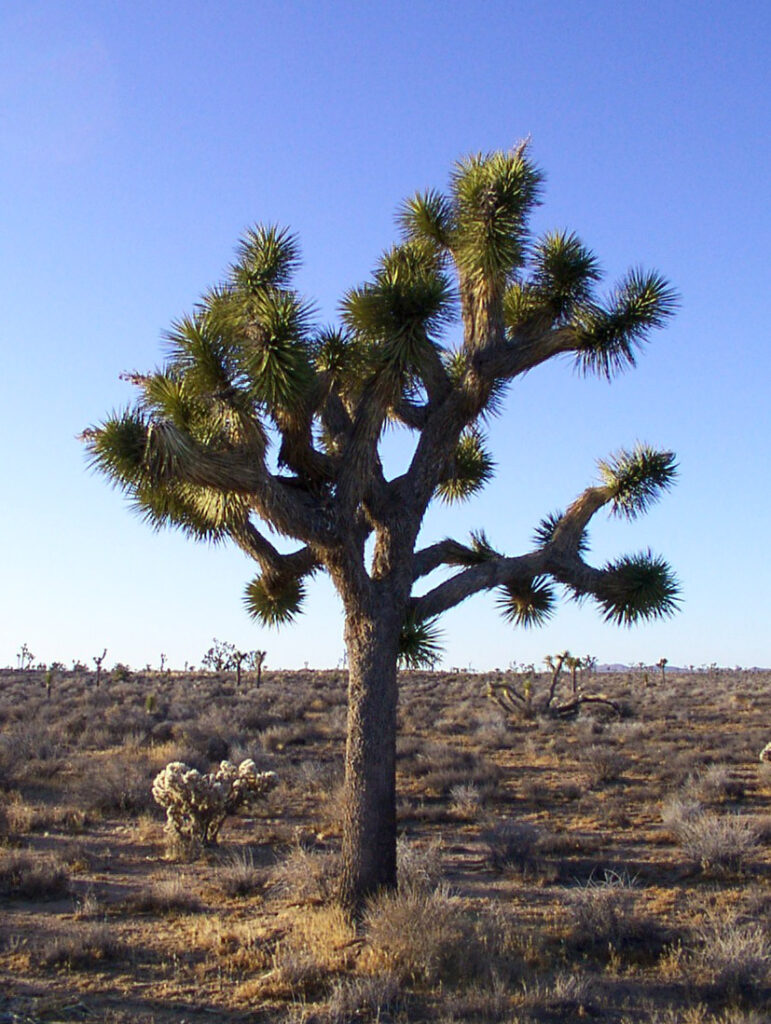
A Joshua tree looks like someone tried to build a tree from verbal instructions.
Tall trunk.
Branches.
Leaves.
Yes.
But the branches appear to begin at arbitrary points and continue in directions that feel negotiated individually.
The leaves are stiff blades.
The bark is fibrous.
The whole plant resembles a tree and also clearly remembers being a yucca.
This is because it is a yucca.
Not a Tree in the Usual Sense
Joshua tree is the common name for Yucca brevifolia.
It is a large monocot related to other yuccas and agaves.
So when the plant grows 30 or 40 feet tall and occupies the visual role of a tree, it is doing so using a different developmental toolkit from an oak or pine.
There are no conventional growth rings for easy aging.
The trunk is fibrous rather than built from the familiar annual wood layers of a typical tree.
The architecture comes from repeated growth, flowering, branching and damage over a long life.
The result looks strange partly because you are comparing it with the wrong blueprint.
Why the Branches Begin Where They Do
Joshua trees do not simply branch continuously.
Flowering can stimulate branching.
Damage can too.
A plant may remain relatively unbranched for years and then divide after a flowering event.
Over decades, repeated episodes create the irregular candelabra form associated with mature Joshua trees.
This means the silhouette records history.
One branch may follow flowering.
Another may reflect injury.
The plant grows as a sequence of events rather than toward one ideal shape.
It is less architecture than autobiography.
The Yucca Moth Deal
Joshua trees depend heavily on specialized yucca moths for pollination.
The relationship is famous because it is unusually reciprocal.
The female moth actively collects pollen and deliberately places it on another flower’s reproductive structures.
She also lays eggs in the flower.
Her larvae later eat some of the developing seeds.
The plant gets pollinated.
The moth gets a nursery and food.
Not every seed is consumed.
The relationship persists.
National Park Service descriptions call the moth an essential pollination partner.
This is not a casual insect visit.
It is a negotiated reproductive system millions of years old.
The Joshua tree looks strange.
Its sex life is even more specialized.
The Desert Is Colder Than the Postcard
Joshua trees are Mojave Desert plants.
That encourages people to imagine heat as the defining environmental condition.
Heat matters.
So does winter cold.
NPS material notes that Joshua tree distribution is tied partly to winter temperatures cold enough to trigger aspects of the life cycle.
The Mojave is a high desert in many places.
Winter nights can freeze.
Snow occurs.
The plant is not simply a cactus substitute designed for maximum heat.
It occupies a specific climate envelope.
This matters enormously under climate change.
Seedlings Are the Future Problem
Old Joshua trees can persist for decades in places where new seedlings are no longer establishing successfully.
That creates a deceptive landscape.
A grove still looks full.
The mature trees remain.
But if recruitment fails, the future population is already declining invisibly.
Joshua Tree National Park reports reduced seedling survival at lower, warmer elevations as the park becomes hotter and drier.
Climate projections suggest suitable habitat within the park could shrink dramatically by the end of the century, especially under higher warming scenarios.
This is not a story about every adult Joshua tree disappearing next year.
It is a story about where replacement remains possible.
Fire Was Not Supposed to Be This Common
Mojave Desert vegetation historically grew with enough open space that fires did not move easily across huge continuous areas.
Invasive annual grasses changed that.
Species such as red brome and cheatgrass fill gaps between shrubs and trees with fine fuels.
After wet periods, those grasses can grow abundantly.
Then they dry.
Fire has a path.
Joshua trees are poorly adapted to frequent intense wildfire.
The 2020 Dome Fire in Mojave National Preserve killed an estimated 1.3 million Joshua trees, according to NPS.
That number is difficult to absorb.
A species visually associated with emptiness can disappear at landscape scale once the spaces between plants begin carrying fire.
Some Can Resprout
Joshua trees can reproduce from seed.
Some can also sprout vegetatively from roots or branches after damage.
That ability provides limited resilience after disturbance.
It is not a universal reset button.
Severe fire can kill plants outright.
Repeated fire can prevent recovery.
Seedling establishment depends on climate, moisture and interactions with animals and nurse plants.
Recovery is therefore slower and less certain than the phrase “can resprout” suggests.
Again, the individual plant may be tougher than the ecosystem trend around it.
The Name Comes From People, Not Botany
The common story says Mormon settlers named the plant because its branches resembled the biblical Joshua raising his arms.
That explanation is widely repeated, though the precise origin is difficult to verify conclusively.
This is a useful moment for restraint.
Not every satisfying origin story is equally documented.
What is documented is that Indigenous peoples have long used and lived among yuccas of the Mojave, including Joshua trees, before the plant received its English common name.
The landscape had names and relationships long before national-park signage.
It Looks Like That Because It Has to
Take the plant apart conceptually:
- yucca growth form;
- flowering-linked branching;
- fibrous trunk;
- stiff evergreen leaves;
- specialized moth pollination;
- cold-desert climate;
- long life under drought.
The silhouette becomes less arbitrary.
A Joshua tree is not failing to resemble a normal tree.
It is succeeding at being a very large desert yucca.
The mistake was ours.
The Future Silhouette
Joshua Tree National Park contains hundreds of thousands of Joshua trees today.
The question is what the landscape looks like after decades of warming, altered fire and changing recruitment.
Managers are protecting potential climate refugia, suppressing fires in sensitive habitat, controlling invasive plants and experimenting with restoration.
None of this guarantees the current distribution persists.
A species can remain iconic while its geography changes underneath the icon.
For now, the plants still stand across the Mojave with their irregular arms.
Every one looks slightly improvised.
That may be the most accurate possible appearance for a species negotiating a desert that is changing faster than its own growth.
Related: Quaking Aspen Is One Giant Tree Pretending to Be a Forest · 12 Trees You Keep Calling a Pine Tree · 10 Hammocks for Sleeping Terribly Between Two Trees
Leave a Reply