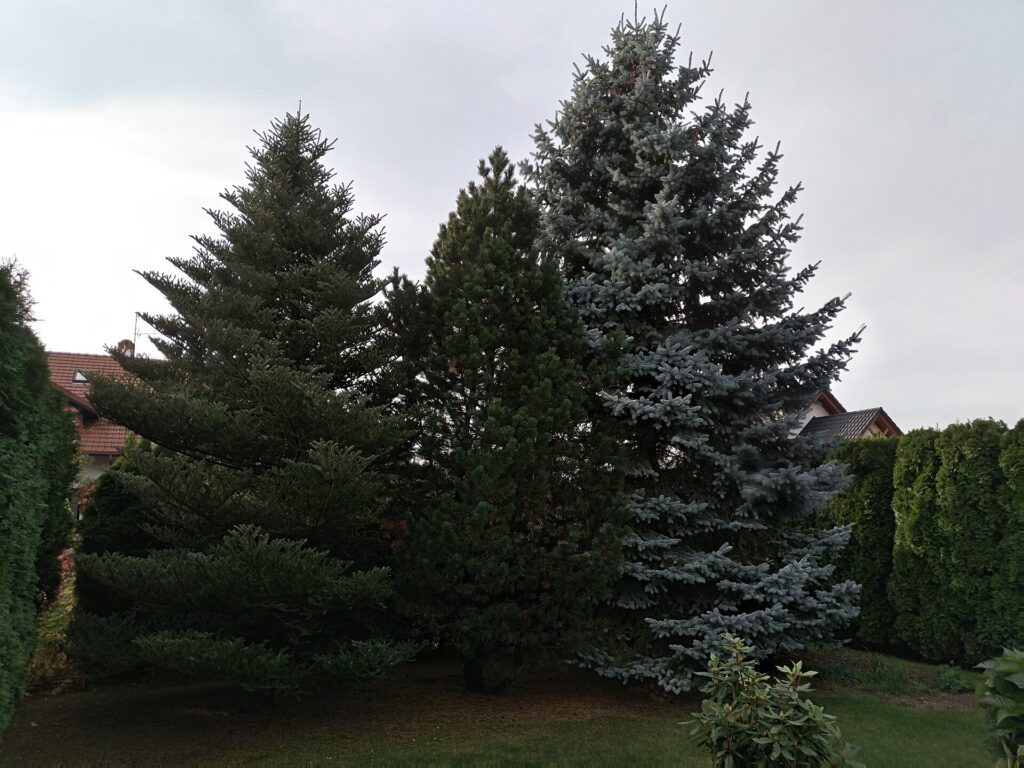
There is a common tree-identification system in North America.
If it has needles, call it a pine tree.
If it has leaves, call it a tree.
If bark is white, become briefly confident about birch.
This system is efficient and wrong often enough to be interesting.
“Conifer” is the broader useful category here. Pines are conifers, but so are spruces, firs, hemlocks, larches, junipers and several trees carrying names that actively undermine beginners.
Here are twelve.
1. Eastern White Pine — An Actual Pine
We should begin by rewarding you.
Eastern white pine is genuinely a pine.
Its needles grow in bundles of five.
That bundle count is one of the easiest pine clues in eastern North America. The needles are soft, slender and flexible compared with many other conifers.
The cones are long and narrow.
If you remember one thing:
white pine = five needles per bundle.
You are already doing better than “pine tree.”
2. Red Pine — Also a Pine, Now Count to Two
Red pine usually carries needles in bundles of two.
The needles are longer and stiffer than eastern white pine and can snap cleanly when bent.
The bark on mature trees often develops reddish plates.
Pines generally package needles into bundles called fascicles.
This is the major structural clue separating them from spruces and firs, whose needles attach individually.
Tree identification has revealed itself to be counting.
You can do this.
3. Ponderosa Pine — The Pine That Smells Like a Bakery Argument
Ponderosa pine commonly bears long needles in bundles of two or three depending on region and variety.
Mature bark forms large orange-brown plates.
People famously describe ponderosa bark as smelling like vanilla, butterscotch, cinnamon or warm cookies.
Do not build identification entirely around scent.
Human beings can disagree violently about whether a tree smells like vanilla.
Use the needles and bark too.
The tree does not care which dessert won.
4. Lodgepole Pine — Pine Needles in Pairs, Frequently in a Crowd
Lodgepole pine commonly has short, stiff needles in bundles of two.
It grows extensively across western North America and often forms dense stands after disturbance.
Some populations produce serotinous cones that can remain closed until heat helps release the seeds.
That does not mean every lodgepole cone requires fire.
Tree ecology dislikes simple slogans almost as much as tree taxonomy.
5. White Spruce — One Needle at a Time, Now Roll It
Spruce needles attach individually rather than in bundles.
They are generally stiff and four-sided enough that many can be rolled between the fingers.
They also attach to tiny woody pegs on the twig, which can make a bare spruce twig feel rough.
White spruce is widespread across northern North America.
The easiest beginner distinction is:
spruce needles are often sharp, square-ish and individually attached.
The tree has become prickly in both personality and geometry.
6. Blue Spruce — Yes, the Color Helps
Colorado blue spruce can show distinctly bluish or silvery needles, although color varies.
Like other spruces, needles attach individually and tend to be stiff and sharp.
The cones hang downward.
Do not use blue color alone to identify every ornamental conifer.
Landscaping has created many cultivars whose only purpose seems to be making field guides nervous.
Still, when a stiff-needled spruce is aggressively blue, the name is finally trying to help.
7. Balsam Fir — Flat Needles, Upright Cones
True firs belong to the genus Abies.
Their needles typically attach individually and are flatter and softer than spruce needles.
Balsam fir has aromatic flat needles and cones that stand upright on branches rather than hanging down.
That upright-cone habit is one of the most satisfying fir clues.
The cones often break apart while still on the tree, which is why you may not find intact fir cones lying underneath.
The tree has removed the evidence.
8. Douglas-fir — Not a True Fir
Douglas-fir is one of the most important trees in western North America.
It is not a true fir.
Botanically it belongs to the genus Pseudotsuga, separate from the true firs in Abies.
The cones are wonderfully useful: distinctive three-pointed bracts stick out between the scales, often described as looking like mouse tails or tiny rear legs.
This is a tree whose common name contains a hyphen because taxonomists are trying to warn you.
Please respect the punctuation.
9. Eastern Hemlock — Tiny Flat Needles and Tiny Cones
Eastern hemlock has short, flat needles arranged along slender twigs and small hanging cones.
The underside of the needles shows pale lines.
The foliage often creates graceful drooping branch tips, and mature trees can form cool dense forests.
It is not related to the poisonous herbaceous plant called poison hemlock.
Common names have now managed to make a tree sound both incorrect and lethal.
The tree is innocent.
10. Eastern Redcedar — Not a Cedar
Eastern redcedar is actually a juniper: Juniperus virginiana.
Its foliage is scale-like or awl-like rather than pine-needle-like, and female plants can produce blue berry-like cones.
Birds make extensive use of the fruit.
The name “redcedar” persists because common names are not legally required to cooperate with botanical relationships.
So:
not pine,
not true cedar,
still tree.
Excellent work, everyone.
11. Western Redcedar — Also Not a True Cedar
Western redcedar belongs to Thuja, the arborvitae group, not the true cedars of genus Cedrus.
It has flattened sprays of scale-like foliage and small elongated cones.
It is enormously important ecologically and culturally in the Pacific Northwest, including to many Indigenous peoples.
Calling it “pine” erases considerably more than taxonomy.
At minimum, give this one its own noun.
12. Tamarack — The Conifer That Drops Its Needles
Tamarack, also called eastern larch, is a deciduous conifer.
Its soft needles grow in clusters and turn golden before dropping in autumn.
Yes, a conifer can lose all its needles.
No, the tree is not dying every November.
This is the final exam for the beginner identification system.
Needles do not automatically mean evergreen.
Nature has noticed your categories and introduced an exception.
The Beginner Conifer Cheat Sheet
You do not need to memorize everything.
Start with attachment.
Pines: needles usually occur in bundles.
Spruces: needles are individual, often sharp and four-sided; twigs feel rough.
True firs: needles are individual, typically flatter and softer; cones often stand upright.
Hemlocks: short flat needles, small cones, delicate-looking foliage.
Junipers/“redcedars”: often scale-like foliage and berry-like cones.
Larches/tamaracks: soft clustered needles that turn color and fall.
Then use cones, bark, geography and tree shape to narrow the identification.
After a while you will stop calling every conifer a pine tree.
You will begin calling them “some kind of spruce.”
This is genuine progress.
Related: Quaking Aspen Is One Giant Tree Pretending to Be a Forest · Why Joshua Trees Look Like That · 10 Hammocks for Sleeping Terribly Between Two Trees
Leave a Reply