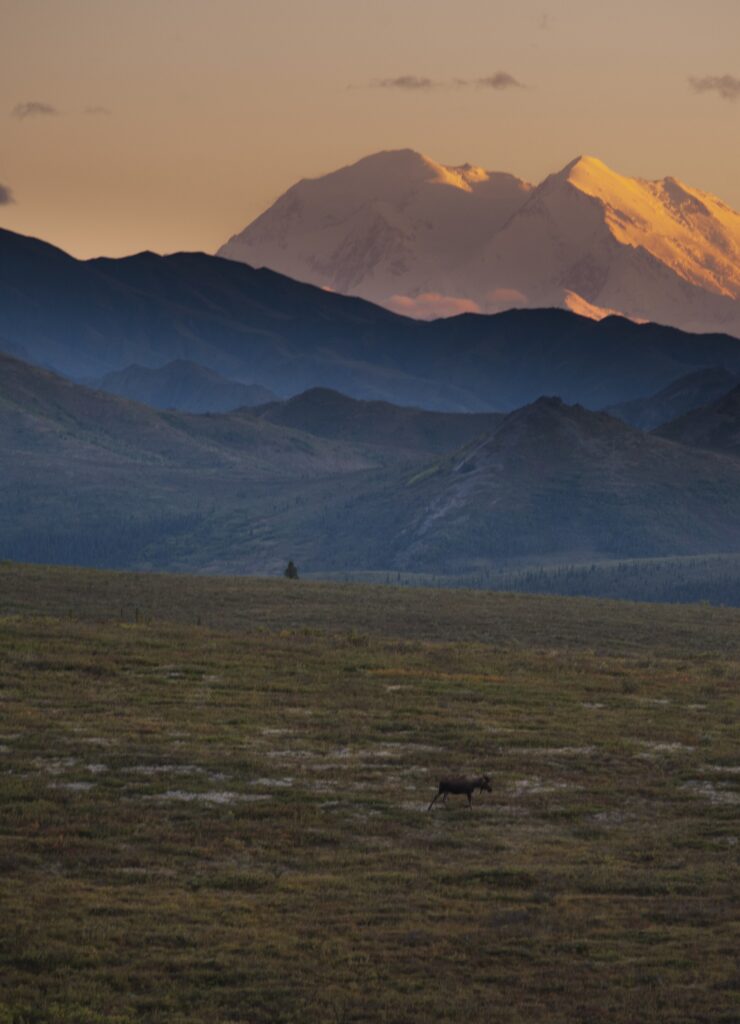
The moose looks unfinished.
The legs are too long.
The torso is enormous.
The head extends into an oversized nose.
The neck has a hanging flap.
Males periodically add antlers that can span several feet, then drop them and begin again.
If you assembled an ungulate from spare parts and left before the final review, you could plausibly get a moose.
The remarkable thing is that the shape works.
Very well.
The Largest Deer
Moose are the largest members of the deer family.
In northern populations, big bulls can exceed 1,000 pounds, with especially large Alaska animals reaching much higher.
At Isle Royale, National Park Service material describes an average moose as standing more than six feet at the shoulder and weighing nearly 1,000 pounds.
The shoulder is already above many human heads.
Then the neck and head continue.
The scale explains part of the apparent awkwardness.
A moose is not a deer enlarged evenly.
Different body parts are exaggerated because they solve specific problems.
The Legs Are for the World the Moose Lives In
Long legs look ridiculous on pavement.
Moose did not evolve for pavement.
Their habitat includes deep snow, wetlands, bogs, lakeshores, brush and uneven northern terrain.
Long legs help an animal move through snow and water while keeping the huge body above the mess.
NPS education material also notes that the hooves can spread to improve balance on soft, uneven ground.
The design is less “tall deer” than “swamp and snow vehicle.”
This is why a moose can look ungainly while standing still and surprisingly capable when moving.
The animal is not badly designed.
The parking lot is the wrong test environment.
Moose Swim Extremely Well
Moose spend substantial time around wetlands and lakes.
They feed on aquatic plants and can swim strongly.
Their long legs, huge lung capacity and buoyant body make water less of an obstacle than the shape suggests.
NPS material notes that moose can submerge their heads and feed on aquatic vegetation.
The nose is adapted for this too; nostrils can close while underwater.
This gives the moose one of its more improbable behaviors:
A thousand-pound deer can disappear headfirst into a lake because lunch is down there.
The moose has not fallen in.
It is browsing.
The Nose Has a Job
The huge muzzle is easy to mock.
It gives the face the expression of an animal whose snout was stretched in post-production.
But a broad flexible muzzle helps the moose browse twigs, leaves and aquatic plants.
Moose eat a wide range of vegetation depending on season.
Willow and other woody browse become important.
Aquatic plants contribute during warmer months.
Winter changes everything.
Food quality declines, snow deepens, movement becomes costly, and the animal may rely heavily on woody plants.
The large body that makes a moose impressive also makes survival expensive.
A moose needs a lot of plant.
The Antlers Are Temporary
Male moose grow antlers each year.
These are bone, not horns.
They are used in display and competition during the breeding season and then shed.
This is an astonishing metabolic project.
An animal grows enormous bone structures for a limited seasonal purpose, uses them, drops them, and starts again the following year.
The antlers also make the already unbalanced visual design considerably wider.
This has produced centuries of artwork portraying moose as if antlers are permanent equipment.
They are not.
For much of the year, bulls do not have them.
The head remains extremely large anyway.
Cold Is the Design Brief
Moose are cold-adapted animals.
Large body mass conserves heat.
A dark coat absorbs solar radiation.
Thick fur insulates.
Long legs help move through snow.
This is excellent in winter.
It becomes a problem in heat.
NPS research on Isle Royale describes summer heat as a growing challenge for moose and notes that warmer conditions can contribute to heat stress.
Moose may seek cool water or shade when temperatures rise.
At the southern edge of their range, climate warming combines with other stressors such as parasites, disease and changing food availability.
This is an important reminder that adaptations have context.
The huge heat-retaining body is not universally good.
It is excellent for one climate.
Change the climate and the same equipment becomes a liability.
Winter Ticks Make the Problem Worse
Moose can carry winter ticks.
In bad infestation years, the numbers can become extraordinary.
NPS Isle Royale material notes that individual animals can host very large tick burdens.
The irritation causes moose to groom excessively, breaking and removing insulating hair. Animals with substantial hair loss may look pale or gray and are sometimes called “ghost moose.”
The problem is not merely cosmetic.
Blood loss and hair loss can contribute to poor condition, especially after a difficult winter.
Warmer conditions can favor tick survival in some regions.
The giant cold-adapted animal is therefore vulnerable not because it is weak, but because multiple parts of its ecology are tuned to a climate changing beneath it.
Moose Are Not Slow
This deserves emphasis.
A moose looks as though rapid movement would violate several structural assumptions.
It does not.
Moose can run quickly.
They can charge.
They can kick.
They can move through brush and water with considerably more competence than a person staring at the proportions might predict.
This matters for safety.
People sometimes treat large herbivores as passive because they are not predators.
A moose does not need to eat you to be dangerous.
A thousand pounds moving defensively is enough.
Give moose space, especially cows with calves and bulls during rut.
The animal is not awkward enough to protect you from it.
The Shape Makes Sense
Take the pieces separately:
- long legs for snow and wetlands;
- broad hooves for unstable ground;
- enormous body for cold;
- dense coat for insulation;
- broad muzzle for browsing;
- aquatic feeding ability;
- annual antlers for competition.
The moose stops looking badly designed.
It looks highly specific.
That specificity is why a moose standing beside a road seems so bizarre.
Roads are flat, open, dry, engineered spaces.
The moose is built for a northern landscape of snow, willow, bog, water, forest and seasonal scarcity.
Put the animal back into that landscape and the proportions stop arguing.
Mostly.
The nose remains a lot.
Related: Area Moose Requests Everyone Just Calm the Fuck Down · The Wolverine: 40 Pounds of Absolutely Not · The American Badger Has Had Enough of This
Leave a Reply