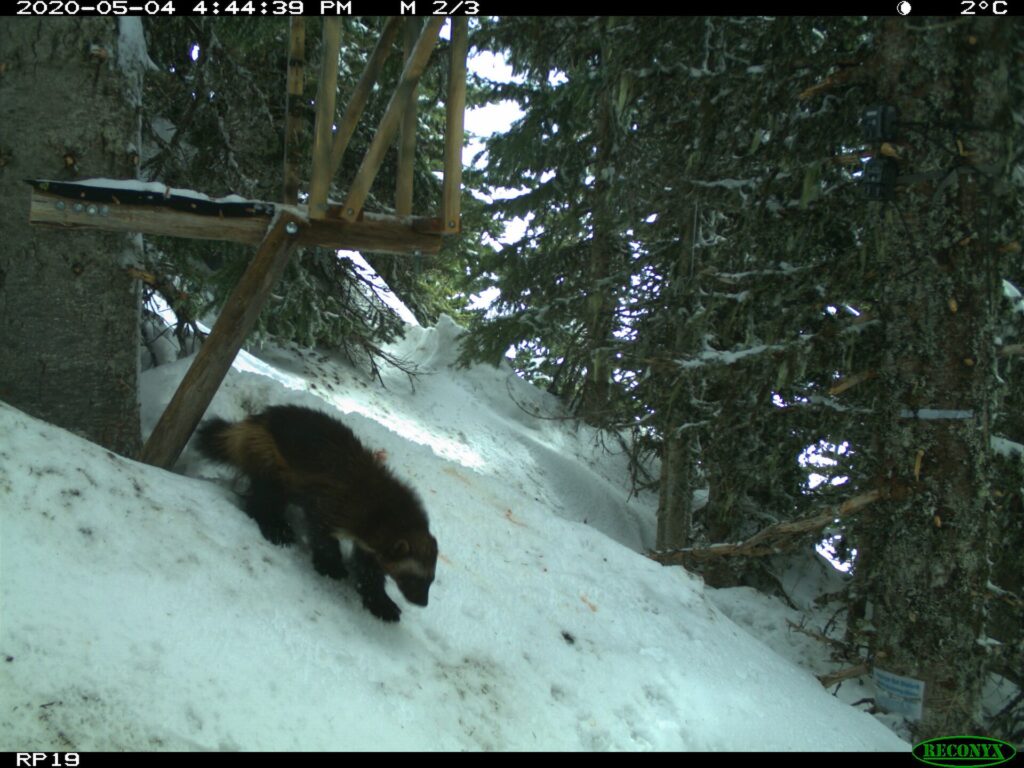
The wolverine has a branding problem.
Its name has been assigned to a comic-book character, sports teams, armored vehicles, knives, boots, and at least one type of person who owns too much tactical equipment.
The actual animal is smaller than the reputation.
A wolverine is a member of the weasel family.
U.S. Fish and Wildlife Service lists adult males at roughly 26 to 40 pounds and adult females at about 17 to 26 pounds.
This means one of North America’s most intimidating mammals can weigh less than a medium-size bag of dog food.
The mistake is assuming size is the relevant measurement.
It is not.
The relevant measurement is what the animal is built to do.
Start With the Weasel Part
Wolverines belong to Mustelidae, the same broad family as weasels, otters, martens, mink and badgers.
They do not look especially delicate.
The body is low, broad and muscular. The head is blocky. The feet are large. The coat is dense and dark, often with pale stripes or patches running along the sides.
At a glance, a wolverine can look like a small bear that has been compressed vertically.
This is misleading but understandable.
Wolverines occupy cold, snowy landscapes across the northern world, with populations extending through Alaska, Canada and Eurasia. In the contiguous United States they persist mainly in high-elevation portions of the northern Rockies and Cascades, with scattered observations elsewhere.
The U.S. Fish and Wildlife Service lists the contiguous-U.S. population as threatened under the Endangered Species Act.
That status reflects concern not because wolverines are fragile animals in the ordinary sense, but because they need a great deal of the right kind of landscape.
The Animal That Keeps Moving
Wolverines occur at very low densities and use enormous home ranges.
That alone makes them difficult to study.
An animal may cross mountains, basins and jurisdictional boundaries while a human researcher is still figuring out whether the camera trap batteries are alive.
Their large home ranges are partly a consequence of living in cold, relatively unproductive environments where food can be spread thinly across huge areas.
Wolverines are opportunistic eaters.
They take small prey, eggs, vegetation and other foods, but scavenging is central to the reputation.
A carcass buried in snow is not necessarily unavailable.
A frozen animal is not necessarily finished.
A wolverine is equipped with powerful jaws and teeth and is capable of exploiting food other scavengers may struggle to access.
This is where the mythology begins to seem less exaggerated.
The animal does not need to defeat everything alive.
It only needs to arrive at something dead in weather you did not want to be outside in.
Winter Is the Point
Wolverines remain active year-round.
They are strongly associated with cold, snowy environments.
Females excavate reproductive dens in deep snow and often use complex structures created around avalanche debris, logs, rocks and snow.
The relationship with persistent spring snow is one reason climate change matters so much.
The Fish and Wildlife Service’s 2023 listing decision concluded that the contiguous-U.S. population was not then in immediate danger of extinction but was likely to become endangered within the foreseeable future, with climate-driven habitat loss and other stressors reducing long-term viability.
Yellowstone’s wildlife research likewise highlights concern about declining spring snowpack suitable for denning.
The wolverine has therefore achieved an awkward ecological position:
An animal famous for toughness depends on a habitat condition humans are steadily making less reliable.
That does not make the animal less tough.
It makes toughness irrelevant to thermodynamics.
The Snow Is Infrastructure
It is tempting to describe climate threats in vague language.
“Cold-adapted species may be affected by warming.”
For a wolverine, snow is more concrete than that.
Snow affects denning.
Snow changes access to food.
Snow changes competition.
Snow changes the structure of the landscape itself.
A deep drift around fallen timber creates protected spaces a female can use for dens.
As spring snow retreats earlier and high-elevation cold zones shrink, the useful terrain can fragment into what Yellowstone researchers describe as islands of alpine and boreal habitat.
Wolverines can travel extraordinary distances.
They still need somewhere appropriate to go.
Connectivity becomes as important as raw acreage.
A mountain range full of small isolated cold patches is not necessarily the same thing as one functioning landscape.
Are Wolverines Actually Ferocious?
They are powerful carnivores.
They can defend food and survive extremely harsh conditions.
They have also accumulated a level of legend that makes it sound as though every wolverine spends the afternoon fighting a grizzly bear for recreation.
That is not useful natural history.
The better version is more interesting.
Wolverines are adapted to making a living where food is scattered, winter is long, snow is deep, and the distance between resources can be enormous.
They survive partly through persistence.
They travel.
They investigate.
They cache food.
They scavenge.
They exploit a cold world efficiently enough that humans, watching from considerably warmer buildings, interpreted the result as rage.
You Probably Will Not See One
This is one of the defining facts of wolverines.
They are rare.
They are sparsely distributed.
They use remote terrain.
They move over large areas.
Even in ecosystems where they occur, seeing one is unusual.
Yellowstone documented only seven individual wolverines in eastern Yellowstone and adjoining national forests during one collaborative study from 2006 to 2009.
This is not like visiting a bison herd.
There is no scenic turnout marked WOLVERINE AREA, NEXT 1/4 MILE.
A sighting can become a serious wildlife event.
That rarity is part of the animal’s cultural power.
The wolverine seems like a creature from a larger, colder version of North America that still exists only in pieces.
Forty Pounds of Absolutely Not
The headline is unfair to many wolverines, which weigh less.
It is also accurate to the emotional experience of the animal.
A wolverine is not huge.
It does not need to be.
It is a low, muscular scavenger-predator built for snow, frozen food, long travel and survival in landscapes where humans require layering systems, traction devices, satellite communication and a detailed weather forecast.
The animal arrives with fur.
That is enough.
The most impressive thing about the wolverine is not that it is fearless.
It is that a relatively small member of the weasel family evolved into something capable of treating winter as normal operating conditions.
The problem now is not whether the wolverine can handle winter.
It is whether winter continues showing up in the places the wolverine needs it.
Related: The American Badger Has Had Enough of This · Why the Moose Is Such a Terrible Shape · The Pronghorn Is Not an Antelope and Has Places to Be
Leave a Reply