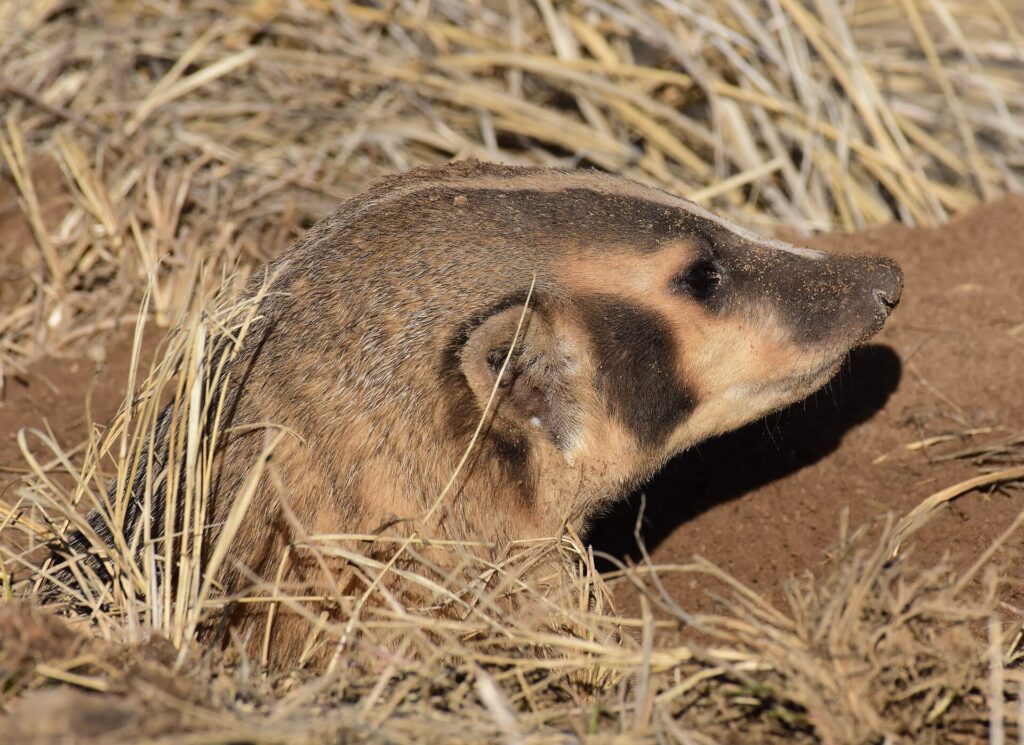
The American badger looks irritated because we recognize irritation better than anatomy.
Its face has black-and-white markings that suggest intensity.
Its body is low and wide.
Its shoulders look overbuilt.
Its forelimbs end in enormous claws.
When confronted, it can flatten itself, bare its teeth, hiss, growl and generally produce the impression that a small patch of prairie has become legally hostile.
This encourages a simple explanation:
The badger is angry.
A better explanation is that the badger is a digging machine.
Start With the Ground
American badgers live across large parts of western and central North America in open habitats including grasslands, prairies, shrublands, agricultural land and open woodlands.
The key resource is not a particular type of scenery.
It is diggable soil and prey underneath it.
Ground squirrels, pocket gophers, mice, prairie dogs and other burrowing mammals can make up an important part of the diet.
The badger solves the problem with excavation.
U.S. Fish and Wildlife Service material describes badgers as fast diggers capable of pursuing prey into burrows.
That sentence is worth sitting with.
For most predators, a ground squirrel reaching a hole has escaped.
For a badger, the prey has selected the construction phase.
Built Like a Shovel With Teeth
Badgers are mustelids, relatives of weasels, otters, martens and wolverines.
Their body plan has been pushed toward digging.
The animal is broad and low to the ground.
The forelegs are powerful.
The claws are long.
The neck and shoulders are heavily muscled.
Even the profile makes sense once you stop asking why it looks angry and start asking what happens when it needs to move several cubic feet of prairie.
A badger can excavate rapidly enough that prey escaping underground may not actually be escaping.
The badger follows.
This also means badger signs can be easier to find than badgers themselves.
Fish and Wildlife Service descriptions note that the animals are mostly nocturnal and seldom encounter people directly, but tracks and conspicuous digging holes may reveal their presence.
You are more likely to find the construction site than the contractor.
Burrows Are Not Just for Hunting
Badgers also dig for shelter.
They use burrows for resting, protection and raising young.
In suitable soil they may excavate repeatedly rather than maintaining one permanent residence.
This is another reason the landscape around a badger can appear unusually worked over.
From the human perspective, the animal has made holes.
From the badger’s perspective, it has made:
- shelter;
- hunting access;
- sleeping quarters;
- protection from weather;
- and occasionally a nursery.
We tend to describe digging as behavior.
For a badger it is infrastructure.
The Coyote Partnership Is Real
One of the stranger well-documented facts about American badgers is that they sometimes hunt in association with coyotes.
The partnership makes sense.
A coyote is fast above ground.
A badger is effective underground.
If a ground squirrel bolts from a burrow, the coyote can chase it.
If it dives underground, the badger can excavate.
Fish and Wildlife Service reporting describes the association as mutually beneficial in some situations.
This is not a permanent buddy-cop arrangement.
Badgers and coyotes also hunt independently.
Still, the pairing is a useful demonstration of how ecology can produce relationships that would seem too cute if a children’s movie invented them.
One animal covers the exit.
The other begins digging.
The prairie dog has discovered interdepartmental coordination.
Defensive Is Not the Same as Mean
Badgers have a formidable reputation.
Some of it is earned.
An animal adapted to digging out rodents and defending itself at close quarters is not a thing to handle.
But “badgers are aggressive” can flatten more useful behavior into personality.
Wild badgers usually have little reason to interact with people.
They are mostly nocturnal, solitary and focused on prey.
When threatened, they can defend themselves vigorously.
The sensible human response is not to test the vigor.
Give the animal space.
Do not corner it.
Do not send a dog toward it.
Do not convert an unexpected wildlife sighting into an opportunity for increasingly close phone video.
The badger has plenty to do.
None of it requires your participation.
Why So Low and Wide?
The body shape is often described comically because it is comical.
The badger looks like someone compressed a carnivore until it became more difficult to tip over.
That is useful.
A low center of gravity helps during digging and close-range struggle underground.
Powerful forequarters deliver force into the soil.
The wide body and muscular build turn the animal into something well matched to resisting movement.
Again, we interpret the result as attitude.
It is mostly engineering.
Badgers and the Landscape
Badgers are predators of burrowing mammals, which means their ecology is tied to the structure of open-country ecosystems.
They need prey.
They need soil they can excavate.
They need enough room to forage.
Agricultural conversion, roads, development and habitat fragmentation can affect local populations, while individual badgers also adapt surprisingly well to altered open landscapes where prey persists.
Their digging itself can affect soils and create disturbed patches used by other organisms.
A badger is not simply living on a prairie.
It is physically rearranging it.
The Animal Behind the Reputation
There is a tendency to make mustelids into little psychopaths.
Wolverines become rage.
Honey badgers become internet mythology.
American badgers become permanently furious pancakes.
The real animals are better.
An American badger is a specialized predator using physical strength and extraordinary excavation ability to exploit prey hidden beneath the ground.
Its face is striped.
Its posture is low.
Its claws are enormous.
It sometimes cooperates with coyotes.
It spends much of the day underground and much of the night digging other things out of underground.
No additional personality disorder is required.
If you meet one, let it continue with its evening.
It has had enough of this.
Related: Area Badger Badgers Wisconsin Badgers’ Badger · The Wolverine: 40 Pounds of Absolutely Not · The Pronghorn Is Not an Antelope and Has Places to Be
Leave a Reply