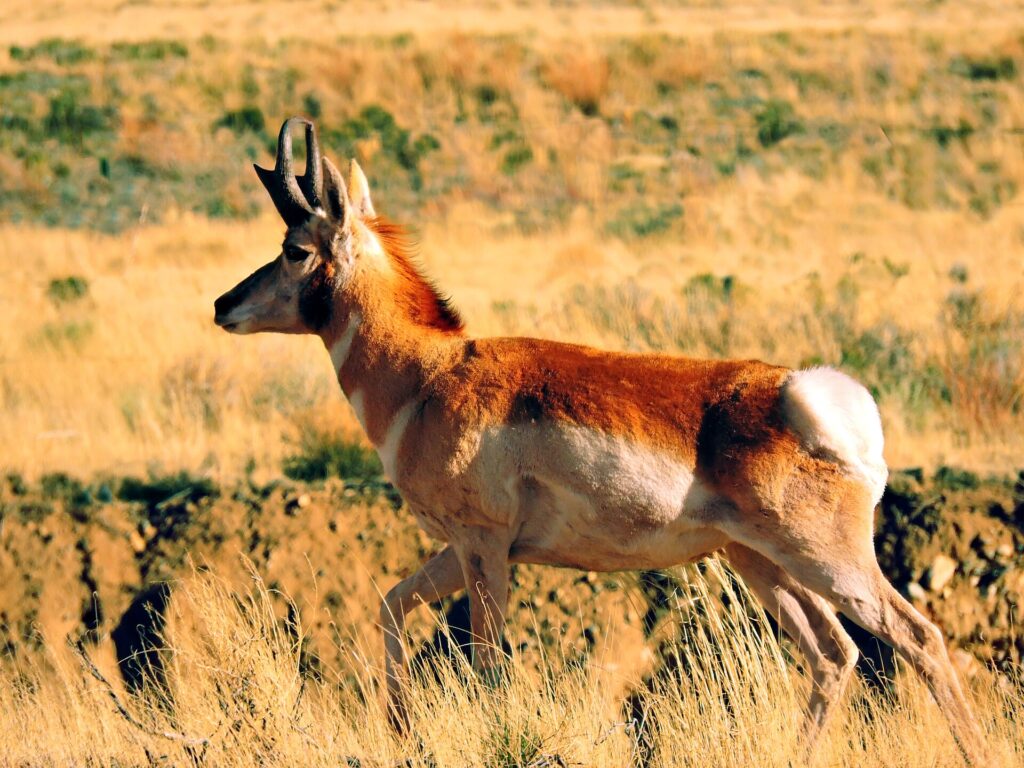
The pronghorn has spent centuries being introduced incorrectly.
American antelope.
Prairie antelope.
Antelope-goat.
Explorers compared it with deer, goats, sheep and African antelope because the animal looked familiar enough to invite comparison and strange enough that none of the comparisons worked.
Today we can be more precise.
The pronghorn is not an antelope.
It is the last living species of an ancient North American family.
It is also extremely fast.
Those two facts explain much of the animal.
The Last Antilocaprid
The pronghorn’s scientific name is Antilocapra americana.
It is the only surviving species in the family Antilocapridae.
NPS fossil resources note that this family was once much more diverse in North America.
Now there is one.
That alone makes the pronghorn biologically unusual.
Its nearest living relatives are not the antelopes it resembles but giraffes and okapi within the larger ruminant family tree.
This does not make the animal look more like a giraffe.
It makes taxonomy more entertaining.
The Horns Are Doing Their Own Thing
Pronghorn horns are neither standard deer antlers nor ordinary permanent horns.
Like other horned mammals, they have a bony core covered by a keratin sheath.
Unlike most horned mammals, pronghorn shed and regrow the outer horn sheath.
NPS describes them as the only animals that do this annually.
Males have larger pronged horns.
Females can also have horns, usually much smaller and without the dramatic prong.
So the animal called pronghorn has:
- actual horns;
- a prong;
- a sheath it sheds;
- and an annual schedule that behaves slightly like antlers.
The naming committee finally got one part right.
Speed Is the Famous Part
Pronghorn are the fastest land mammals in North America.
Depending on source and measurement, top speed estimates often reach roughly 50 to 60 miles per hour.
More important than the peak number is endurance.
Pronghorn can sustain very high speeds much longer than a cheetah can maintain its famous sprint.
NPS material describes speeds around 45 miles per hour for extended distances and very high peak speeds over shorter runs.
The body is adapted accordingly.
Long legs.
Light frame.
Large lungs and windpipe.
Large heart.
Highly developed vision.
Cushioned feet.
Everything about the animal suggests one central instruction:
Leave quickly.
Why So Fast?
This is where natural history becomes tempting.
Modern pronghorn in much of their range have no predator that obviously requires such spectacular speed.
One popular hypothesis is that the speed evolved under pressure from extinct Pleistocene predators, including the so-called American cheetah, Miracinonyx.
NPS sources discuss this idea.
It is plausible and widely repeated.
It is also better presented as an evolutionary hypothesis than as a settled scene from the Ice Age.
We cannot film the race.
The useful point is that pronghorn evolved in a North American predator community different from the one they inhabit today.
Their speed may be an ecological inheritance.
The animal is carrying performance specifications for a competitor that no longer arrives.
Open Country Is Part of the System
Pronghorn are animals of open plains, basins and sagebrush country.
Speed works best when you can see the threat and have somewhere to run.
Their enormous eyes and broad field of view suit that landscape.
The white rump patch can also serve as a visual signal when animals become alarmed.
In open country, information travels.
One animal sees danger.
The herd responds.
Then the entire group departs at a speed that makes every nearby cow look stationary.
Speed Is Not the Whole Animal
The headline version of the pronghorn is always speed.
The landscape version is movement.
Seasonal access to open winter range, summer range, water and migration corridors determines whether all that athletic ability can actually be used. A pronghorn does not benefit much from being one of the continent’s fastest mammals if fences, highways and subdivisions turn the route into a sequence of dead ends.
That is why corridor conservation belongs in the same conversation as top speed.
The Fence Problem
There is one complication.
Pronghorn are reluctant jumpers compared with deer.
They often prefer to crawl under fencing.
This makes conventional livestock fences significant movement barriers.
A species built to cross huge landscapes rapidly can be stopped by several strands of wire.
That is an extraordinary mismatch.
Migration routes become especially important.
Some pronghorn populations travel long distances between seasonal ranges, and maintaining connected corridors is a major conservation concern.
NPS sources describe one of the best-known migrations between the Upper Green River Basin and Grand Teton region at around 150 miles.
The animal can run fifty miles per hour.
Then it reaches a fence.
Modernity has discovered a cheaper predator.
Migration Is Not Optional Recreation
Pronghorn migration follows food, snow conditions, seasonal habitat and landscape structure.
The animals need access to different places at different times of year.
Roads, subdivisions and fencing can narrow or block those movements.
Conservation therefore becomes less about protecting one park and more about protecting the spaces between protected places.
This is a recurring western wildlife problem.
A national park can hold extraordinary habitat.
The animal may still leave.
The boundary on the map has no equivalent in pronghorn behavior.
Not Antelope
We could simply stop calling pronghorn antelope.
People probably will not.
“Antelope” is short, familiar and now culturally embedded in the American West.
The better goal may be understanding the error.
A pronghorn is its own thing.
An ancient North American lineage.
A horned ruminant with annually shed sheaths.
A long-distance migrant.
An open-country specialist.
A mammal fast enough that the speed itself has become an evolutionary mystery.
It looks like something we already know because the human brain likes categories.
The animal has spent millions of years refusing the category.
Then it leaves at fifty miles per hour.
Related: The American Badger Has Had Enough of This · The Wolverine: 40 Pounds of Absolutely Not · Why the Moose Is Such a Terrible Shape
Leave a Reply