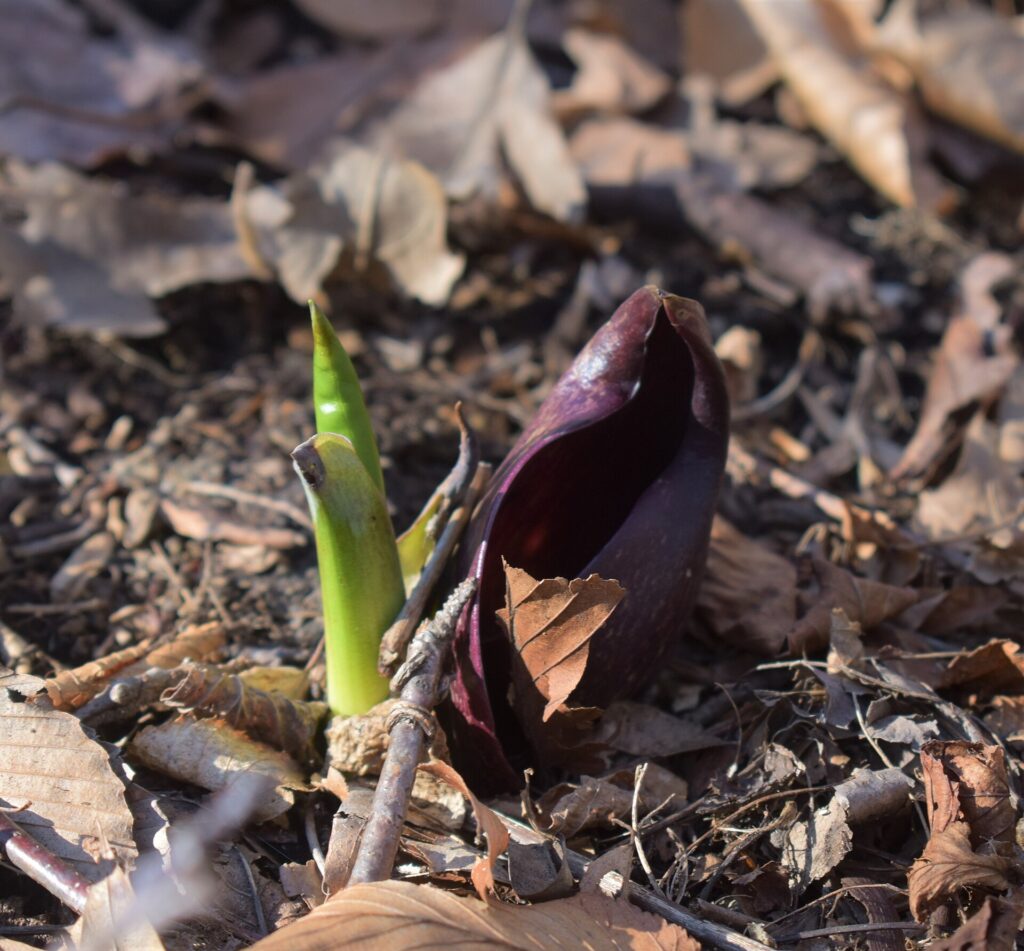
Late winter in a wet forest looks mostly inactive.
Snow.
Mud.
Dead leaves.
Gray trunks.
Then, in a saturated patch of ground, a strange purple hood pushes upward.
Inside it is a cluster of tiny flowers.
The temperature inside can be dramatically warmer than the air outside.
The plant is making heat.
This is skunk cabbage.
It has central heating.
The Flower Comes First
Eastern skunk cabbage, Symplocarpus foetidus, is one of the earliest native plants to flower in much of its range.
The flower structure can appear before the large green leaves.
A mottled maroon or purple hood called a spathe surrounds a fleshy central structure called a spadix.
The tiny flowers occur on the spadix.
If this sounds familiar, it is because skunk cabbage belongs to the same larger plant family as several other species with spathes and spadices, including the famous corpse flower.
One group produces a nine-foot tourist attraction.
The other appears quietly in a Midwestern swamp while snow is still present.
Both understand odor.
Thermogenesis Is Real
Skunk cabbage is thermogenic.
It can generate metabolic heat inside the flowering structure.
University of Illinois Extension summarizes measurements showing the spathe can remain 15 to 35 degrees Fahrenheit warmer than surrounding air, with much larger differences reported under some conditions.
That heat can melt nearby snow and ice.
A plant in February can therefore create a tiny warm zone around its reproductive organs.
This is one of those botanical facts that would sound like a metaphor if the thermometer were not involved.
The plant is not merely surviving winter.
It is operating a heated room.
Where Does the Heat Come From?
The plant burns stored carbohydrates through cellular respiration.
Most living organisms produce metabolic heat.
Skunk cabbage produces enough, in a concentrated enough location, for the heat to become ecologically conspicuous.
The spadix can regulate temperature during parts of flowering rather than simply warming unpredictably.
Research on thermogenic aroids suggests this warming may improve reproductive conditions and help volatilize scent compounds.
This leads directly to the other famous skunk-cabbage feature.
It smells.
The Smell Is Also the Point
Crush skunk cabbage and the odor can be unpleasant.
The flowers themselves can produce odors attractive to early-season pollinators such as flies and beetles.
Heat helps carry volatile compounds into the air.
The warm flower chamber may also provide a temporary microhabitat for insects during cold weather.
The plant has therefore assembled a complete early-spring advertising system:
warmth,
odor,
shelter,
pollen.
No petals required.
The forest floor is still half frozen and skunk cabbage has opened a heated roadside diner for flies.
It Does Not Literally Melt Its Way Up From Deep Snow
This is where popular descriptions can become cartoonish.
Skunk cabbage can melt snow immediately around the flower.
That does not mean the plant is tunneling upward through several feet of snow like a botanical submarine.
Snow depth, air temperature and plant metabolism all matter.
The important fact is smaller and better:
The flower can create enough heat to alter the environment directly around itself.
A plant has crossed from “tolerates cold” to “locally negotiates with cold.”
Then the Leaves Become Enormous
After flowering, skunk cabbage produces large bright-green leaves.
The plant goes from a weird purple object in mud to something with the visual presence of tropical foliage.
These leaves capture energy that will be stored underground for future growth and flowering.
The plant’s underground system is perennial and substantial.
Older plants can become deeply rooted.
The roots can contract and gradually pull the growing crown deeper into the soil over time.
This helps explain why transplanting a mature wild skunk cabbage is not a casual operation.
Leave it where it is.
The plant has invested heavily in real estate.
Wetlands Are Part of the Story
Skunk cabbage grows in wet soils, swampy woods, seeps and stream margins.
It is associated with places where groundwater and saturated organic soils shape the plant community.
These environments are often dismissed as muddy or unpleasant.
They are ecologically rich.
A patch of skunk cabbage can be one of the first visible signs in spring that the wetland is becoming active again.
Insects arrive.
Amphibians become active.
Water moves.
Leaves expand.
The entire season begins from a patch of ground that still looks too cold.
One of the Rare Hot Plants
Plant thermogenesis exists in several unrelated groups, but it is uncommon enough to feel surprising.
We tend to imagine plants as passive recipients of temperature.
They warm when the sun shines.
They cool when the air cools.
Skunk cabbage complicates that.
The flower has a thermal strategy.
That strategy costs stored energy.
The payoff is reproductive opportunity before many competitors are active.
Early flowering provides access to a limited but potentially effective group of pollinators.
The plant has found a niche in time as much as in space.
The Name Has Done It No Favors
Skunk cabbage.
This is not premium branding.
The name foregrounds the smell and the giant leaves and makes the plant sound like something discovered behind a dumpster.
It leaves out:
- thermogenesis;
- early-season flowering;
- wetland ecology;
- temperature regulation;
- specialized pollination.
We name Bald Eagles after their appearance.
We name skunk cabbage after the moment someone damaged a leaf.
This is unequal treatment.
A Small Heated Room in the Snow
Find skunk cabbage in late winter and it changes the season slightly.
The woods no longer look entirely dormant.
Something is actively spending energy.
The spadix is warm.
The scent is moving.
Insects are arriving.
The plant has started its reproductive year before the canopy trees have leaves.
All of this occurs in a structure the size of something you could cover with one hand.
Central heating does not need ducts.
Sometimes it needs starch and a purple hood.
Related: The Corpse Flower Smells Like Death on Purpose · Quaking Aspen Is One Giant Tree Pretending to Be a Forest · The Bristlecone Pine Has Been Standing Here Since Before Most of Our Problems

Leave a Reply