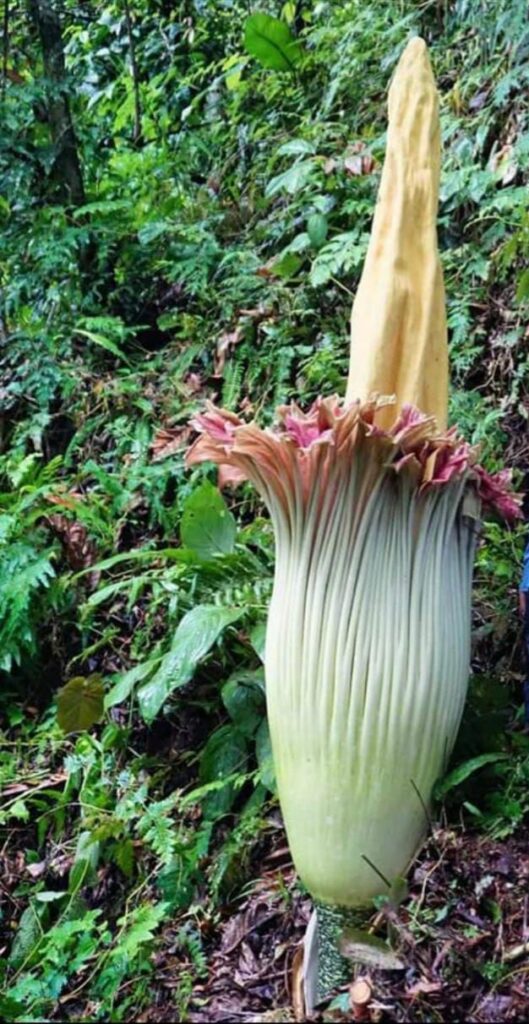
The corpse flower spends years preparing to smell terrible.
This is commitment.
A mature plant stores energy underground in a corm that can weigh well over a hundred pounds.
Most of the time, it produces a giant leaf.
Then, when sufficient energy has accumulated, it may send up an inflorescence several feet tall.
The structure warms itself.
It releases a smell commonly compared with decomposing meat.
People line up for hours to experience this.
The flies are the intended audience.
It Is Not One Giant Flower
The common name is misleading.
Amorphophallus titanum produces the world’s largest unbranched inflorescence.
An inflorescence is a structure containing many flowers.
The tall central spike is the spadix.
The enormous frilled structure around it is the spathe.
The actual individual flowers are small and arranged near the base of the spadix.
So when someone says, “That is the world’s largest flower,” the polite correction is:
Not exactly.
Then stop.
Nobody standing in line wants the lecture unless they ask.
The Smell Is Chemical Advertising
Corpse flowers attract carrion-associated insects.
The odor can include chemical compounds associated with rotting meat and other unpleasant biological smells.
To a carrion beetle or fly, this can signal opportunity.
The plant is essentially producing a false carcass advertisement.
The insect arrives.
There is no meat.
There is pollen.
This is pollination by fraud.
Very successful fraud.
Then the Plant Heats Up
The inflorescence generates heat.
The U.S. Botanic Garden notes that this warming helps the odor travel farther.
Heat increases volatilization and movement of scent compounds.
The tall spadix also acts as a structure from which warm odor can disperse into surrounding air.
The corpse flower is therefore not merely smelly.
It is actively improving smell distribution.
This plant has marketing.
The Bloom Is Short
The spectacle does not last long.
The U.S. Botanic Garden describes peak bloom as lasting only a few days.
The odor is strongest during part of that period.
Then the huge structure collapses.
This is after years of energy storage.
The ratio of preparation to performance is astonishing.
Imagine training for the Olympics for seven years and your event is smelling like a dead mammal for Thursday and Friday.
Then everyone goes home.
The Timing Helps Prevent Self-Pollination
Female and male flowers do not become active at exactly the same time.
Female flowers typically become receptive first.
Male flowers release pollen later.
This temporal separation reduces the likelihood of self-pollination.
In botanic gardens, staff may manually collect, store and apply pollen to maintain genetic diversity among cultivated plants.
That creates one of the stranger jobs in horticulture:
waiting for a giant plant to smell like decomposition and then carefully managing its sex life with refrigerated pollen.
Botany contains careers no child predicts.
The Corm Pays the Bill
The underground corm stores carbohydrates.
The plant draws on that reserve to produce either the huge leaf or the flowering structure.
After blooming, the corm is depleted and must rebuild energy before flowering again.
The interval is irregular.
The U.S. Botanic Garden says plants may wait a few years or more than a decade between blooms.
This is why corpse-flower events become news.
The plant does not follow an annual schedule for human convenience.
It flowers when the energy budget says yes.
The Leaf Is Also Ridiculous
When the plant is not blooming, it can produce a single enormous leaf on a tall stalk.
That leaf branches into many leaflets and can look like a small tree.
Again, this is one leaf.
The corpse flower seems determined to make ordinary botanical vocabulary sound dishonest.
One flower? No, thousands.
One tree? No, one leaf.
One potato? Closer.
The corm is an underground stem.
Native to Sumatra
Corpse flowers are native to the rainforests of Sumatra, Indonesia.
The species faces habitat loss in the wild.
The crowds surrounding cultivated blooms in American botanic gardens can create the odd impression that corpse flowers are thriving everywhere.
They are not.
Botanic-garden collections play roles in education, research and genetic conservation.
A line of people taking selfies with a smelly plant is therefore connected, however loosely, to a real conservation problem thousands of miles away.
The jokes are at the greenhouse.
The habitat loss is not.
Why Does It Look Like That?
The visual design and smell are linked.
Large size.
Elevated spadix.
Heat.
Dark red-purple interior.
Carrion odor.
The plant presents a multi-sensory imitation of something dead enough to investigate.
Pollinating insects do the rest.
This is not a beautiful flower that happens to smell bad.
The bad smell is the strategy.
The beauty is our problem.
Why Botanic Gardens Make a Spectacle of It
The crowds are not entirely a sideshow.
A rare, unpredictable bloom gives botanic gardens a chance to explain Sumatra’s rainforest ecology, pollination, plant conservation and the difference between a flower and an inflorescence to people who arrived because something smells dead.
That is an unusually effective educational funnel.
The corpse flower gets visitors through the door with decomposition and sends at least some of them home knowing what a spadix is.
The Most Successful Awful Smell in Horticulture
Botanic gardens can receive tens of thousands of visitors for a corpse-flower bloom.
Humans know exactly what the smell is supposed to resemble.
We arrive anyway.
We wait in line.
We enter the greenhouse.
We lean toward the plant.
Then we say some version of:
Oh wow.
That is bad.
The plant has achieved the rarest possible marketing success.
Its entire public identity is based on producing an unpleasant experience, and demand increases every time it happens.
The flies were there first.
Related: Skunk Cabbage Is Heating Its Own House · Quaking Aspen Is One Giant Tree Pretending to Be a Forest · The Bristlecone Pine Has Been Standing Here Since Before Most of Our Problems

Leave a Reply