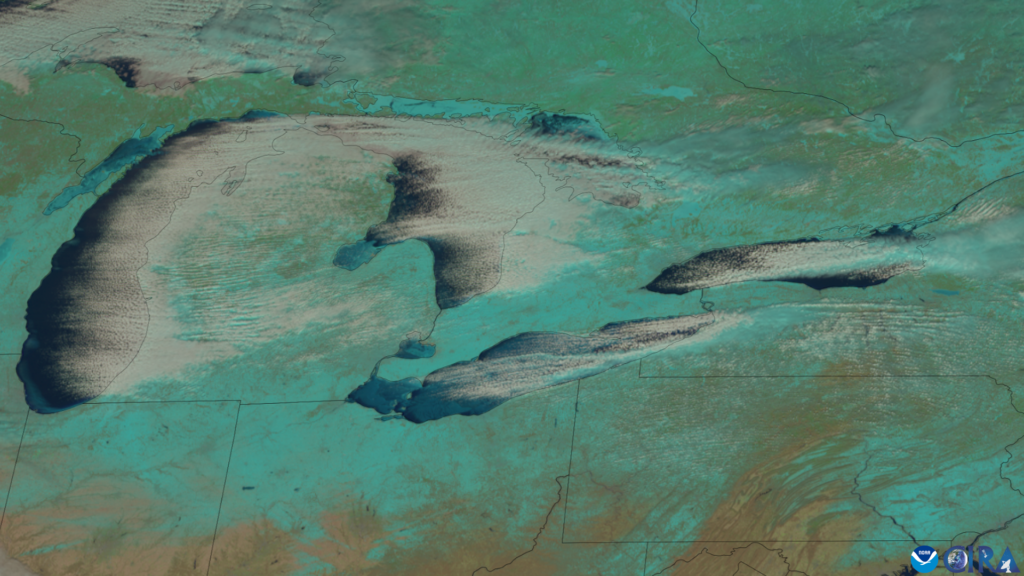
Lake Michigan does not create winter.
Canada assists.
The jet stream assists.
Large-scale pressure systems do most of the atmospheric scheduling.
But once cold air reaches the Great Lakes, the lakes can take over locally with enough force to bury one town in snow while sunlight appears a few miles away.
This is called lake effect.
It is the moment freshwater becomes meteorology.
Start With Cold Air Over Warmer Water
Lake-effect snow often develops when cold, dry air moves across relatively warmer unfrozen lake water.
The air picks up heat and moisture from the surface.
Warmer moist air rises.
As it moves downwind and cools, clouds grow.
If conditions are favorable, snow forms.
This can organize into narrow bands.
National Weather Service guidance notes that these bands may produce snowfall rates of two or three inches per hour or more.
The lake does not create the cold air.
It modifies it.
Significantly.
Fetch Is a Wonderful Word
Fetch is the distance wind travels across open water.
Longer fetch gives air more time to collect heat and moisture.
Wind direction therefore matters enormously.
A slight change can shift a snow band.
Communities that were buried can stop receiving snow.
Communities nearby can suddenly begin.
This is why lake-effect forecasts can look absurdly precise and still feel arbitrary from the ground.
The atmosphere has created a conveyor belt.
Your house may be under it.
Your coworker’s house eight miles away may not be.
Both of you will have opinions about the forecast.
The Bands Can Be Narrow
This is one of lake effect’s defining characteristics.
Heavy snow may fall in one corridor.
Blue sky can appear nearby.
National Weather Service material specifically notes that the sun may be shining only a mile or two from a heavy band.
This is meteorologically legitimate and socially disastrous.
One person sends a photograph of three feet of snow.
Another person says:
We got nothing.
Both are correct.
The Great Lakes have invented neighborhood-scale credibility disputes.
Why the Great Lakes?
Size.
Depth.
Heat storage.
Geography.
The lakes hold enormous amounts of water and release stored heat slowly as air temperatures fall.
Before ice cover becomes extensive, the water surface can be far warmer than a cold air mass moving overhead.
That temperature contrast drives transfer of heat and moisture.
The larger the open-water path, the greater the potential influence.
This is why a small farm pond does not routinely create a 40-mile snow band.
Scale eventually becomes weather.
Ice Cover Changes the Machine
Open water is crucial.
As lake ice increases, the atmosphere loses direct access to liquid water.
Heat and moisture transfer decreases.
Lake-effect production can weaken.
This is why NOAA explanations often emphasize that lake-effect snow becomes less efficient once lakes freeze over extensively.
Climate change complicates the relationship.
Warmer lakes and reduced ice cover can extend open-water conditions and alter lake-effect potential, while warming air can also change whether precipitation falls as snow or rain.
The simple equation “warmer = more lake-effect snow forever” does not work.
Weather enjoys context.
The Lakes Also Moderate Temperature
Water heats and cools more slowly than land.
That moderates nearby climate.
Spring near a cold lake can remain cooler than inland areas.
Autumn can stay milder.
Coastal agriculture can take advantage of these differences in some regions.
Fruit-growing areas around parts of Michigan, New York and Ontario are influenced by the lakes.
The same body of water that causes terrifying snow squalls can help reduce temperature extremes enough to support orchards.
This feels inconsistent.
It is just thermal inertia.
Lake Breezes Are Smaller Weather
On sunny days, land can heat faster than lake water.
Warm air over land rises.
Cooler air from over the lake moves inland to replace it.
This creates a lake breeze.
The effect can shift temperatures sharply near shore.
Chicago residents experience this regularly.
A spring afternoon can feel warm inland and suddenly become jacket weather near the lake.
The phrase “cooler by the lake” sounds like regional small talk.
It is a pressure-driven circulation system.
Casual meteorology has excellent branding.
Thunderstorms Can React Too
Lake breezes can interact with larger weather systems.
Converging boundaries may help focus clouds or thunderstorms under the right conditions.
Lakes can stabilize air in one season and destabilize it in another depending on temperature relationships.
The water is not simply a snow machine.
It modifies local atmospheric structure throughout the year.
Clouds.
Fog.
Breezes.
Temperature.
Precipitation.
The lakes have several departments.
The “Junior Ocean” Comparison Is Useful Until It Isn’t
The Great Lakes are enormous inland freshwater seas in a physical sense.
They produce waves.
They create coastal climates.
They affect weather.
They support shipping across thousands of miles.
From shore, they have horizons.
Calling them “basically oceans” captures the emotional scale.
Scientifically, the differences matter.
No marine salinity.
Different tidal behavior.
Different circulation.
Different ecosystems.
Different connections to the atmosphere.
The lakes do not need to be oceans to have ocean-like effects.
They are already Great Lakes.
The adjective is doing a lot of work.
Weather by Freshwater
The easiest way to appreciate the scale is satellite imagery.
A cold air mass crosses Lake Superior, Michigan, Erie or Ontario.
Long cloud streets form over the water.
Bands continue inland.
Snow accumulates dramatically downwind.
The lake becomes visible in the atmosphere.
This is a body of water altering cloud formation across hundreds of miles.
Freshwater usually feels passive.
Drink it.
Swim in it.
Sail on it.
Then Buffalo receives several feet of snow because air crossed Lake Erie at the wrong angle.
At that point the lake has entered management.
Related: Michigan Has Enormous Sand Dunes Because the Great Lakes Are Showing Off · The Wolverine: 40 Pounds of Absolutely Not · The American Badger Has Had Enough of This



Leave a Reply