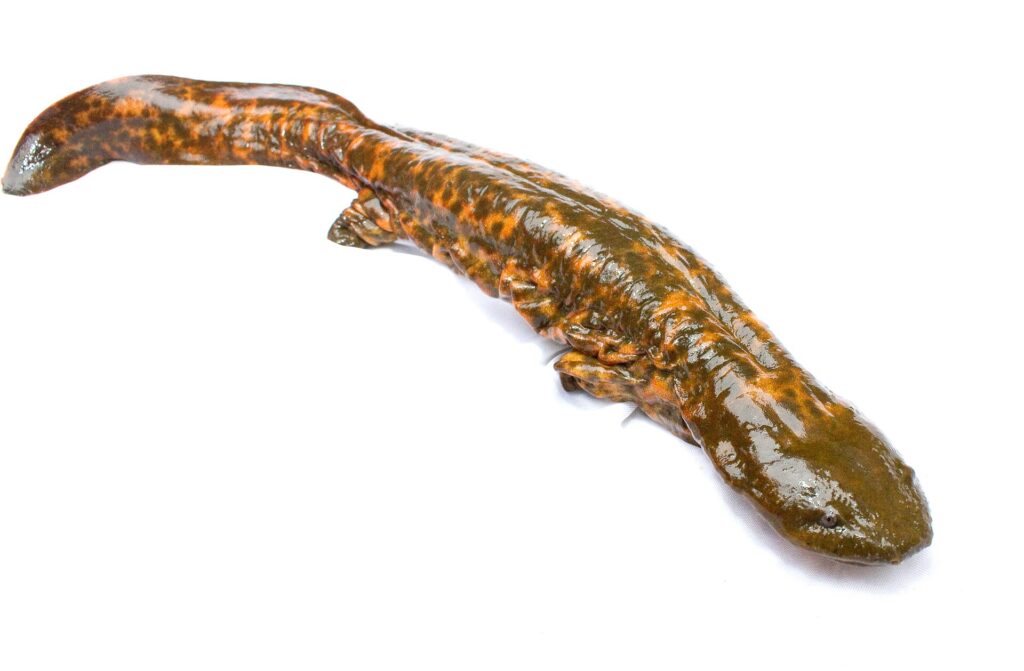
The hellbender is a giant salamander that lives underneath rocks in clean rivers.
That sentence should be enough.
Instead, the animal also has a flattened head, tiny eyes, a broad paddle-like tail, loose folds of wrinkled skin, and a common name that sounds like a minor demon specializing in flood damage.
It can exceed two feet in length.
It breathes largely through its skin.
It spends much of its life hidden beneath one large rock.
This is one of North America’s best animals.
A Salamander the Size of a Small Appliance
Hellbenders are the largest salamanders in North America.
Adults can reach more than two feet long.
Their bodies are broad and flattened, an excellent shape for living in fast-flowing water and sliding under heavy rocks.
The eyes are small.
The legs are short.
The tail is muscular.
The skin along the sides forms loose folds.
From above, the animal looks less like the cheerful salamander of a field-guide illustration and more like something discovered when a river was drained for maintenance.
This has produced many regional names over time.
Mud devil.
Snot otter.
Allegheny alligator.
None improve the situation.
The Wrinkles Are Respiratory Equipment
Hellbenders have lungs.
They rely heavily on gas exchange through the skin.
The folds increase surface area.
That means water quality becomes physically important.
Cool, clear, oxygen-rich streams support the animal’s respiratory system.
Sediment can degrade the spaces under rocks and interfere with habitat.
Pollution can affect water chemistry.
Warm water contains less dissolved oxygen.
A wrinkled body that looks visually excessive is therefore a functional surface.
The hellbender is not badly made.
It is wearing extra lung on the outside.
The Rock Is a House
Adult hellbenders spend enormous amounts of time beneath large flat rocks.
The rock provides shelter from predators and strong currents and creates a stable daytime refuge.
At night, hellbenders emerge to forage.
Crayfish make up a major part of the diet, along with other aquatic prey.
The animal may use the same general shelter area repeatedly.
This is where human disturbance can become surprisingly destructive.
Move a large stream rock and you may be moving the roof of somebody’s house.
Even if the hellbender escapes, altered rock position can degrade the shelter.
For this reason, conservation programs frequently ask river users not to move large rocks unnecessarily in known hellbender habitat.
The salamander has very specific housing requirements.
It cannot afford renovation.
Hellbenders Are Not Dangerous
Folklore has not been kind.
Historically, some people believed hellbenders were poisonous, dangerous to fish, or capable of harming humans.
They are none of these things.
They are not venomous.
They are not a threat to swimmers.
They do not poison water.
They mostly eat crayfish and spend the day underneath rocks avoiding everything.
A two-foot wrinkled amphibian can look alarming if encountered unexpectedly.
That does not make it dangerous.
It makes the encounter excellent.
The Male Guards the Eggs
Hellbender reproduction adds another good detail.
Males establish nest sites beneath rocks.
Females lay long strings of eggs, and fertilization occurs externally.
The male remains at the nest and guards the eggs until they hatch.
Fish and Wildlife Service material for the Ozark hellbender describes clutches that can contain hundreds of eggs and an incubation period lasting weeks.
The male is therefore a large aquatic salamander sitting under a rock defending several hundred eggs while breathing through skin folds.
No fictional embellishment is necessary.
The Conservation Story Is Serious
The hellbender’s strange appearance can carry a lot of humor.
Its decline should not.
The Ozark hellbender is federally endangered.
It is restricted to a small number of river systems in southern Missouri and northern Arkansas and has suffered major population declines.
Fish and Wildlife Service material says abundance in occupied rivers fell by more than 70 percent compared with the 1970s.
The eastern hellbender occupies a much wider range across the eastern and central United States.
Missouri populations are already federally endangered, and the Fish and Wildlife Service has proposed listing the eastern hellbender across its full range as endangered.
As of current 2026 agency material, that range-wide action remains proposed rather than final.
Major threats include sedimentation, degraded water quality, habitat destruction, altered flows, disease and direct mortality.
These are not glamorous amphibian problems.
They are river problems.
Captive Breeding Is Helping
There is meaningful conservation work underway.
Fish and Wildlife Service and partner programs in Missouri have developed captive breeding and head-starting programs, including collaboration with the Saint Louis Zoo and Missouri Department of Conservation.
FWS reported in 2026 that more than 12,000 young endangered hellbenders had been released since 2008 through partnership efforts.
That is an extraordinary number.
It also illustrates the scale of intervention required when wild reproduction and recruitment collapse.
Captive breeding can help rebuild populations.
It does not replace clean rivers.
A salamander designed to breathe through its skin cannot be conserved independently of water quality.
An Indicator Under a Rock
Hellbenders are often treated as indicators of healthy streams.
This should not be interpreted as a magical test where hellbender present equals perfect river.
Ecology is rarely that simple.
But the relationship makes intuitive sense.
An animal requiring cool, clear, oxygenated water, stable rocky shelter and functioning prey communities will struggle when those conditions deteriorate.
Protect the hellbender and you are protecting a lot more than the hellbender.
You are protecting the river structure that allows it to exist.
The River Goblin Deserves Better
The hellbender looks like something designed specifically to make a child interested in amphibians.
Large.
Wrinkled.
Flat.
Secretive.
Lives under a rock.
Name sounds dangerous.
Actually harmless.
Breathes through skin.
Guards eggs.
Eats crayfish.
Needs clean water.
There is almost too much here.
Its survival, unfortunately, depends on very ordinary human decisions:
how much sediment enters streams,
how watersheds are developed,
how sewage and pollutants are managed,
whether large rocks remain in place,
whether rivers stay cool and oxygenated.
The animal sounds mythical.
The conservation work is plumbing, land use and water quality.
This is often how nature works.
The goblin is real.
The boring part is what saves it.
Related: The Wolverine: 40 Pounds of Absolutely Not · The American Badger Has Had Enough of This · Why the Moose Is Such a Terrible Shape

Leave a Reply