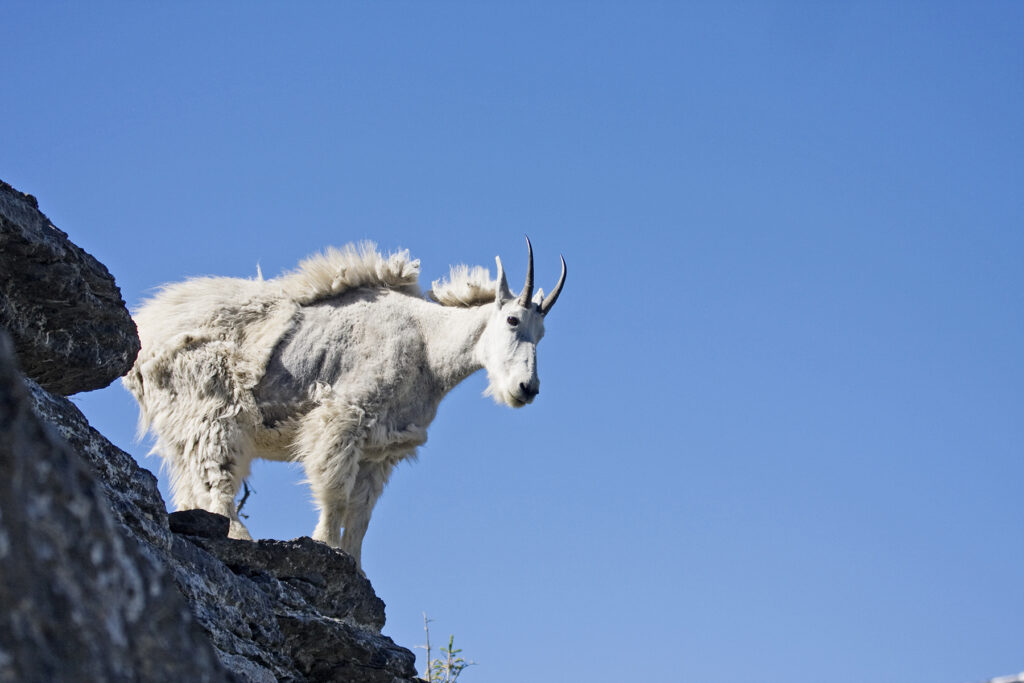
A mountain goat standing on a cliff produces two simultaneous thoughts.
First:
Beautiful animal.
Second:
Absolutely not.
The ledge may be six inches wide. The slope may be close to vertical. Loose rock may fall away beneath it. The goat will look down, place one hoof on something that does not appear to qualify as a surface, and continue walking.
This is not recklessness.
It is anatomy.
Not Really a Goat
Mountain goats are not especially close relatives of domestic goats.
They belong to the genus Oreamnos and are more closely related to goat-antelopes such as chamois and serows than to the barnyard goat your brain is trying to use as reference.
They are native to the mountainous regions of northwestern North America.
Some populations in the United States are native.
Others were introduced for hunting or recreation and later became ecological problems in places where mountain goats did not evolve with the local alpine community.
That distinction matters.
“Mountain goat habitat” on a tourism brochure does not automatically mean the species belongs there historically.
The Hoof Is the Main Trick
National Park Service material describes mountain-goat hooves as split into two toes that can spread for stability.
The harder outer edge can catch on tiny rock irregularities.
The inner pad is soft and flexible.
Together, the hoof can grip rock far better than a rigid hoof would.
This is the equipment that allows a mountain goat to move across slopes steeper than 60 degrees.
It is also why photographs of mountain goats are so emotionally offensive to people afraid of heights.
The goat does not appear to be climbing.
It appears to be standing normally in a place where standing normally has been discontinued.
Then Add the Shoulders
Mountain goats have unusually powerful forequarters.
That helps them pull their bodies upward on steep terrain.
Watch a goat climb and the front half does a surprising amount of the work.
This makes sense in a landscape where going somewhere may mean moving up through broken ledges instead of around them.
Humans developed switchbacks.
The mountain goat developed shoulders.
Both are solutions.
Only one allows you to stand on a cliff face while chewing.
Why Live There?
Because cliffs provide something enormously valuable:
distance from predators.
Mountain goats can use terrain that many predators cannot navigate safely.
Cliff bands also provide access to alpine and subalpine forage.
During summer they eat grasses, sedges, herbs and other plants.
Seasonal movement takes them between feeding areas, mineral licks, winter range and escape terrain.
The cliff is not a stunt.
It is neighborhood infrastructure.
This is another common wildlife misunderstanding.
Humans see a dangerous place.
The animal sees security.
Falling Still Exists
The internet version of the mountain goat sometimes becomes magical.
Hooves grip anything.
Goats never fall.
Gravity has made an exception.
None of this is true.
Mountain goats can slip, fall, become injured and die in steep terrain.
Young animals learn to navigate cliffs over time.
Rockfall, avalanches and severe winters remain real hazards.
The remarkable thing is not that mountain goats are immune to the landscape.
It is that they are competent enough there to make the landscape look harmless.
That is a much more interesting achievement.
Winter Is Worse
Mountain goats do not leave the mountains because the weather becomes unreasonable.
They grow thick winter coats with dense underfur and long guard hairs.
They move to winter ranges where wind, snow depth, forage access and terrain determine survival.
Winter feeding is difficult.
Energy matters.
Disturbance matters too.
An animal forced to repeatedly flee people in winter is spending calories that are expensive to replace.
This is one reason wildlife-distance rules exist even when an animal appears calm.
Calm is not permission.
The goat may simply be conserving energy while waiting for you to stop being part of the afternoon.
The Salt Problem
Mountain goats seek mineral licks and salty areas.
In heavily visited places, that can create strange interactions with people because sweat and urine contain salt.
Goats in some parks have learned to frequent trails, campsites and other places where humans leave concentrated minerals.
This is not charming.
Habituation can make wildlife unnaturally comfortable around people and lead to dangerous encounters.
Do not feed goats.
Do not approach them.
Do not allow them to lick your equipment because the photo seems funny.
Wildlife does not need additional reasons to associate human beings with resources.
We have already provided enough.
Introduced Goats Can Be a Serious Problem
Olympic National Park became one of the clearest examples.
Mountain goats were introduced to the Olympic Peninsula in the 1920s before establishment of the national park.
They were not native there.
The population later affected sensitive alpine vegetation and soils.
The park eventually undertook a large relocation and removal program.
This is a useful correction to the idea that a charismatic wild animal is automatically ecologically beneficial anywhere it can survive.
An animal can be impressive and out of place at the same time.
Ecology is not casting.
Climate Has Reached the Cliffs Too
NPS research warns that changing climate conditions may shrink suitable mountain-goat habitat, particularly toward the southern end of the species’ range.
Alpine systems are especially vulnerable because warmer conditions can move suitable temperature zones upward.
The geometry is unforgiving.
A species can shift uphill only while more mountain remains above it.
Changes in snow, vegetation, parasites, fire and seasonal timing can also alter the habitat around the goats.
Again, the goat is extraordinarily capable.
Capability does not manufacture additional alpine terrain.
The View From the Trail
This is why seeing a mountain goat can feel different from seeing an animal in a meadow.
The landscape is part of the animal.
Take away the cliff and much of the mountain goat’s identity stops making sense.
The hooves.
The shoulders.
The white coat.
The seasonal movements.
The use of escape terrain.
Everything is tied to elevation and rock.
From a trail below, the goat may appear to be standing somewhere impossible.
It is not.
You are the animal for whom that place is impossible.
The mountain goat is at home.
Which does not make the ledge look any better.
Related: The Wolverine: 40 Pounds of Absolutely Not · The American Badger Has Had Enough of This · Why the Moose Is Such a Terrible Shape
Leave a Reply