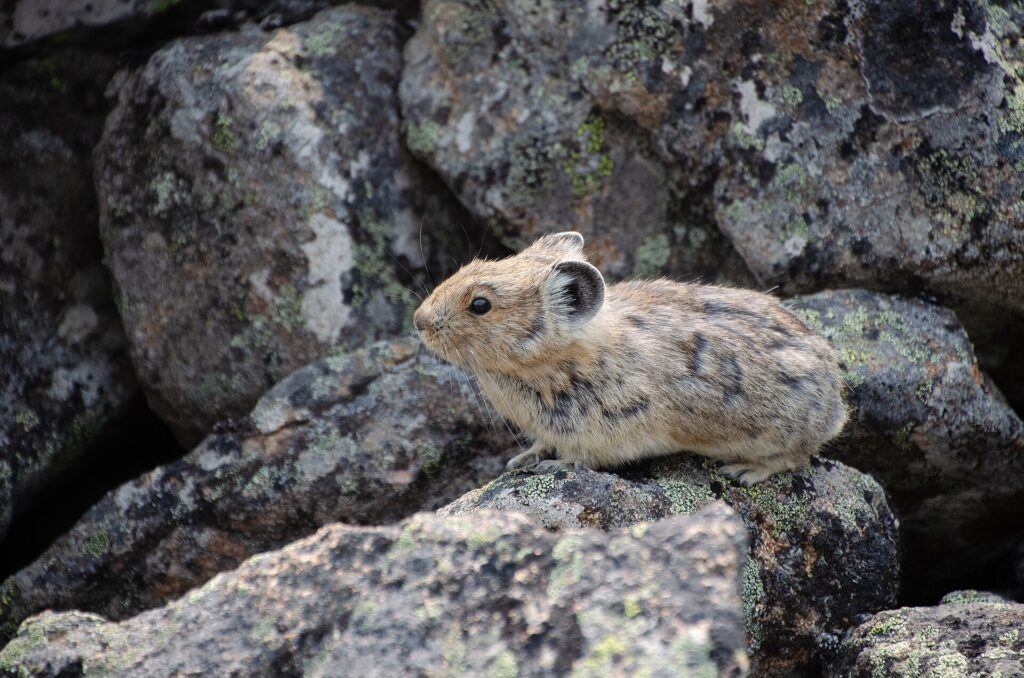
A pika looks like a hamster designed by someone who had recently seen a rabbit.
It is small.
Round.
Ear-forward.
Tail nearly invisible.
It lives among broken rock in western mountains and communicates with a sharp little call that sounds too urgent for an animal roughly the size of a guinea pig.
Then it spends summer making hay.
None of this is the hard part.
The hard part is temperature.
First: It Is Not a Rodent
American pikas are lagomorphs.
They are relatives of rabbits and hares.
This is useful because the body shape encourages everyone to file the animal under “mountain mouse.”
Wrong folder.
Pikas inhabit rocky talus slopes, boulder fields and similar habitats across western North America.
The rocks matter because the spaces underneath create shelter from weather and predators and can provide cooler microclimates.
A pika can move across the surface, disappear between stones and spend substantial time in a three-dimensional world humans mostly perceive as a pile of rocks.
This is home.
Pikas Do Not Hibernate
This is the key to almost everything they do in summer.
Winter is long in alpine environments.
Food disappears under snow.
The pika remains awake.
So it gathers vegetation during the growing season and builds haypiles.
National Park Service sources describe pikas collecting grasses, sedges, ferns, shrubs and even conifer twigs, leaving vegetation to dry before storing it.
Some haypiles are substantial.
Valles Caldera NPS notes that they can reach several feet across.
This is farming without cultivation.
The pika does not grow the crop.
It harvests the mountain aggressively and stores the result under rocks.
A tiny rabbit relative has invented a pantry.
The Hay Is Territory
Pikas are territorial.
They defend the areas around their talus habitat and food stores.
Their sharp calls help communicate with neighbors and warn about predators.
The result is one of the stranger alpine experiences.
You hike across a silent boulder field.
Something squeaks.
You see nothing.
A minute later another squeak comes from somewhere else.
The rocks have opinions.
Eventually, if you are patient, a small round mammal appears on top of one boulder carrying an entire mouthful of plants.
This is a very serious agricultural operation.
Please keep moving.
Built for Cold Means Vulnerable to Heat
Pikas have thick insulating fur and high metabolic rates that help them survive cold environments.
Those adaptations also make overheating a real concern.
NPS research at Mount Rainier describes pikas as especially sensitive to heat and cites experimental work in which sustained exposure to temperatures above roughly 82 degrees Fahrenheit could be fatal under certain conditions.
Other NPS resources emphasize sensitivity beginning at lower temperatures and note that pikas often reduce surface activity during warm parts of the day.
The exact relationship varies with local conditions, access to cool spaces within talus, elevation, moisture and other factors.
That complexity matters.
“Pikas cannot survive warmth” is too simple.
“Pikas are strongly constrained by temperature and climate” is much closer.
Climate Change Does Not Move Every Pika Uphill the Same Way
The phrase “running out of mountain” is useful because it captures a basic problem:
A cold-adapted species at high elevation cannot move uphill forever.
But the real ecology is more complicated.
USGS research has documented local pika losses in parts of the Great Basin, southern Utah and northeastern California, with temperature, precipitation, habitat connectivity and talus characteristics affecting persistence differently by region.
Some populations occupy surprisingly low elevations where cool underground rock structure provides thermal refuge.
Others appear more climate-limited.
This means the pika is not one simple thermometer with fur.
Different mountain systems create different options.
Some talus fields remain cool.
Some retain snow.
Some are connected to other habitat.
Some are isolated.
Climate change acts through this landscape rather than replacing it.
Snow Matters Too
Warm summers are not the only issue.
Snowpack can insulate the spaces where pikas spend winter.
Reduced snow or earlier melt can change the thermal environment under the rocks.
That creates an apparent contradiction:
Too much heat is bad.
Too little insulating snow can also be bad.
Alpine ecology is full of this kind of problem.
Cold-adapted species are not merely asking for “cold.”
They depend on seasonal patterns.
A mountain winter is a schedule, not a temperature setting.
The Pika as Climate Symbol
Pikas became prominent symbols of climate-change impacts because the story is intuitive.
Small animal.
Cold mountaintop.
Warming world.
Nowhere higher to go.
That story is useful, but symbols can simplify animals into messages.
The actual pika remains worth knowing on its own terms.
It has a home territory.
It maintains hay stores.
It spends winter awake beneath snow.
It communicates constantly.
It navigates broken rock at high speed.
It is prey for hawks, coyotes and martens.
It reproduces, competes, hides, feeds and survives in environments that look almost empty from a hiking trail.
Climate change is not the only interesting thing about it.
It is simply becoming one of the most important things.
A Haypile Beside a Warming World
There is something unusually tangible about pika climate ecology.
A forest can shift slowly.
A glacier can retreat over decades.
The pika gives you a small animal carrying a mouthful of flowers across a boulder field because winter food must be assembled before winter arrives.
That behavior has worked for a very long time.
The concern is whether the environmental schedule around it continues working too.
The pika is not literally standing at a summit wondering where to go next.
It is doing what pikas do.
Collecting.
Calling.
Defending.
Eating.
Waiting for winter.
The mountain is the part that is changing.
Related: The Wolverine: 40 Pounds of Absolutely Not · The Mountain Goat Has No Business Being Up There · Why Joshua Trees Look Like That
Leave a Reply