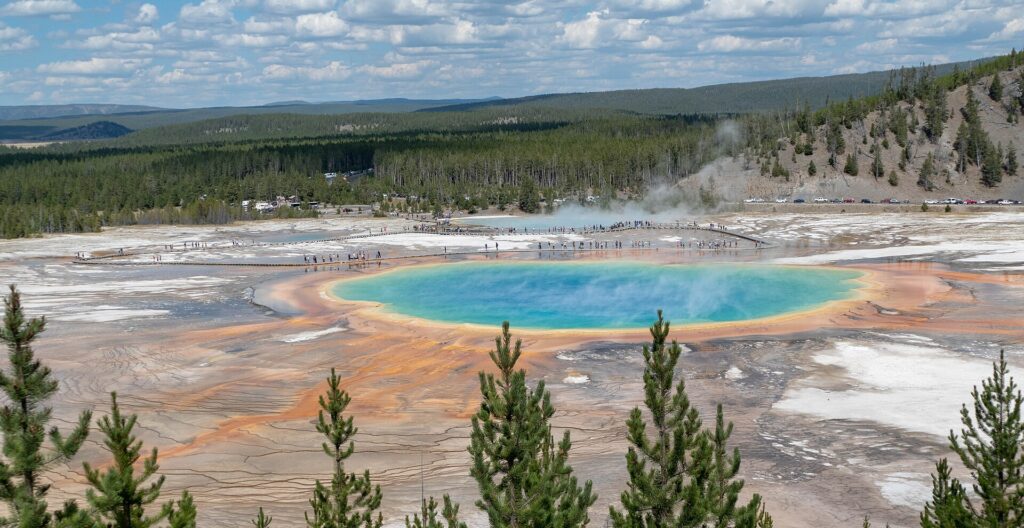
Yellowstone contains more than ten thousand hydrothermal features.
More than five hundred active geysers.
Hot springs blue enough to look digitally altered.
Mud pots that burp gray clay.
Steam vents.
Acid.
Sulfur.
Microbes living in temperatures that would end your afternoon immediately.
The system beneath all this is astonishingly complex.
It is also, according to the National Park Service and U.S. Geological Survey, reasonably described using the word plumbing.
This is excellent news.
Geology has become home maintenance.
Every Geyser Needs Three Things
At the simplest level, Yellowstone’s hydrothermal features require:
heat,
water,
and a pathway through rock.
The heat comes from the Yellowstone volcanic system.
Partially molten rock and hot crust remain below the region.
Rain and snow provide the water.
That water seeps downward through cracks and porous rock.
It is heated.
Then it rises again through fractures and conduits.
That network is the plumbing.
Nothing in this paragraph explains why Old Faithful exists.
It does explain why a volcano can produce a tourist attraction involving scheduled water.
Pressure Keeps Water Liquid
Deep underground, water can become far hotter than its normal surface boiling point.
Pressure matters.
The weight of overlying water and rock prevents immediate boiling.
NPS describes superheated water in parts of Yellowstone’s hydrothermal system exceeding 400 degrees Fahrenheit.
As hot water rises, pressure drops.
Boiling becomes possible.
Steam expands.
If the underground pathway allows free circulation, you may get a hot spring.
If the pathway contains the right constrictions, pressure can build.
Then you may get a geyser.
The difference between tranquil blue pool and periodic explosion can be a bottleneck in the pipe.
Homeownership has never felt more geological.
A Geyser Is a Hot Spring With Bad Circulation
This is not insulting.
It is essentially the mechanism.
NPS describes geysers as hot springs with constrictions in their plumbing systems.
Those constrictions prevent hot water from circulating freely to the surface.
Pressure builds below.
Water begins to boil.
Steam expands.
Some water is pushed out.
That reduces pressure on the deeper reservoir.
More water flashes into steam.
The system erupts.
Then the reservoir empties or cools enough that the eruption stops.
Refill.
Reheat.
Repeat.
Old Faithful is therefore not faithful because it keeps a schedule out of professionalism.
It has a refill-and-pressure cycle that is unusually predictable.
The Plumbing Changes
Geysers are not clocks.
Earthquakes can alter fractures.
Mineral deposits can seal or redirect conduits.
Water supply changes.
Pressure changes.
Hydrothermal explosions rearrange local systems.
An eruption pattern can shift.
A geyser can become dormant.
A hot spring can change character.
USGS emphasizes that subsurface plumbing is dynamic and only partly understood.
This is a useful corrective to the amusement-park version of Yellowstone.
The geyser is not installed.
It is currently happening.
We Can Now See More of the Pipes
For most of Yellowstone’s scientific history, the underground plumbing was inferred from surface behavior, chemistry, geophysics and local measurements.
Recent geophysical surveys have produced much more detailed images.
USGS reported in 2022 that airborne electrical and magnetic mapping revealed large-scale pathways carrying hot fluids beneath hydrothermal areas to depths of roughly one to two miles.
The invisible network began looking more like a network.
Different famous surface features could be connected to deeper structures.
This does not mean scientists now possess a complete plumbing diagram.
It means the hidden system has become less hidden.
We are finally locating some of the pipes.
Do not call a contractor.
Hot Springs Are the Calm Version
Hot springs generally allow enough circulation that heated water can rise and cooler water can sink.
This convection releases heat without creating the same pressure buildup needed for geyser eruptions.
The colors come partly from mineral conditions and thermophilic microorganisms adapted to different temperatures.
The bright orange, yellow, green and brown margins are not decorative staining.
They can be living microbial communities.
A spring may therefore contain:
volcanic heat,
circulating groundwater,
dissolved minerals,
and organisms living at the edge of what many animals can tolerate.
Calling this “a hot pool” is accurate in the way calling New York “a settlement” is accurate.
Mud Pots Are Plumbing With Less Water and More Acid
Mudpots occur where the hydrothermal system has limited water and acidic chemistry breaks surrounding rock into clay.
Gas bubbles through the resulting mud.
Different water levels change consistency.
A wetter mudpot can bubble.
A drier one can spit.
The sound is deeply unserious.
The chemistry is not.
Hydrogen sulfide can be oxidized into sulfuric acid by microorganisms.
Rock decomposes.
Clay forms.
Gas escapes.
The Earth makes oatmeal.
Fumaroles Are Mostly Steam
Fumaroles, or steam vents, occur where the water supply is limited enough that available water can flash into steam before reaching the surface.
NPS describes them as Yellowstone’s hottest hydrothermal features.
They hiss.
They roar.
They smell of sulfur gases.
They remind visitors that the water part of hydrothermal geology is optional at the surface even though water remains central underground.
A geyser performs.
A fumarole sounds like the building is angry.
More Than Half the World’s Geysers
Yellowstone contains roughly half of the world’s active geysers.
That concentration is extraordinary because geysers require a rare combination.
Heat alone is not enough.
Water alone is not enough.
Fractured rock alone is not enough.
You need all three plus the right underground geometry.
Volcanic regions exist around the world.
Large geyser fields are rare.
Yellowstone’s fame is therefore not simply about having a volcano.
It is about having an absurdly successful plumbing arrangement above one.
Stay on the Boardwalk
This is where the joke stops.
Yellowstone’s hydrothermal areas can kill people.
The crust around features can be thin.
Water may be near or above boiling temperature.
Pools can be highly acidic.
Ground that looks solid can collapse.
NPS instructs visitors to stay on boardwalks and designated trails for a reason.
Do not test the surface.
Do not touch the water.
Do not let children or pets wander.
A geyser basin is not a spa.
The water is beautiful because you are observing it from the correct distance.
Basically Plumbing
The metaphor survives because it is genuinely useful.
Reservoirs.
Conduits.
Constrictions.
Pressure.
Flow.
Mineral buildup.
Leaks.
Blockages.
The difference is that the heat source is a volcanic system and the repair interval is geological.
Yellowstone is basically plumbing.
It is just plumbing capable of sending boiling water hundreds of feet into the air while supporting microbial ecosystems and recording the movement of heat from a giant volcanic system below.
So, plumbing.
With context.
Related: Why Death Valley Occasionally Becomes a Lake · The Driftless Area: The Part of the Midwest the Glaciers Somehow Missed · Michigan Has Enormous Sand Dunes Because the Great Lakes Are Showing Off



Leave a Reply